
Missing the Point: When Media, Advocates, and Policymakers Use Data That Exclude Children and Youth
HUD’s “Point in Time” count excludes most homeless children and youth. See what school and early childhood data reveal that policymakers are missing.
The U.S. Department of Housing and Urban Development (HUD) recently released Part 1 of its Annual Homelessness Assessment Report (AHAR) to Congress. The AHAR Part 1 report includes HUD’s “Point in Time” (“PIT”) data on the number of people who were visibly unsheltered or in a homeless shelter on a single night in January. It is widely used by the media, advocates, and policymakers across the political spectrum to make sweeping statements about trends in homelessness and to support or denounce various public policies.
Typically, statements and stories based on the AHAR’s release overlook children and youth because the HUD PIT count excludes most families and youth who experience homelessness. Lack of homeless shelter space in many communities, fear of shelter, and fear of family separation cause most homeless families and youth to resort to situations that are not counted: staying in motels, with other people temporarily, or in other hidden places.
Public schools and early childhood programs, however, identify and serve families and youth under a broader legal definition of homelessness that matches this reality of scarcity, fear, and high mobility. The more realistic definition of homelessness used by the U.S. Department of Education and U.S. Department of Health and Human Services – coupled with compulsory state education laws and federal enrollment requirements – make public schools and early childhood programs much better barometers of family and youth homelessness.
What Schools and Early Childhood Programs Show Instead
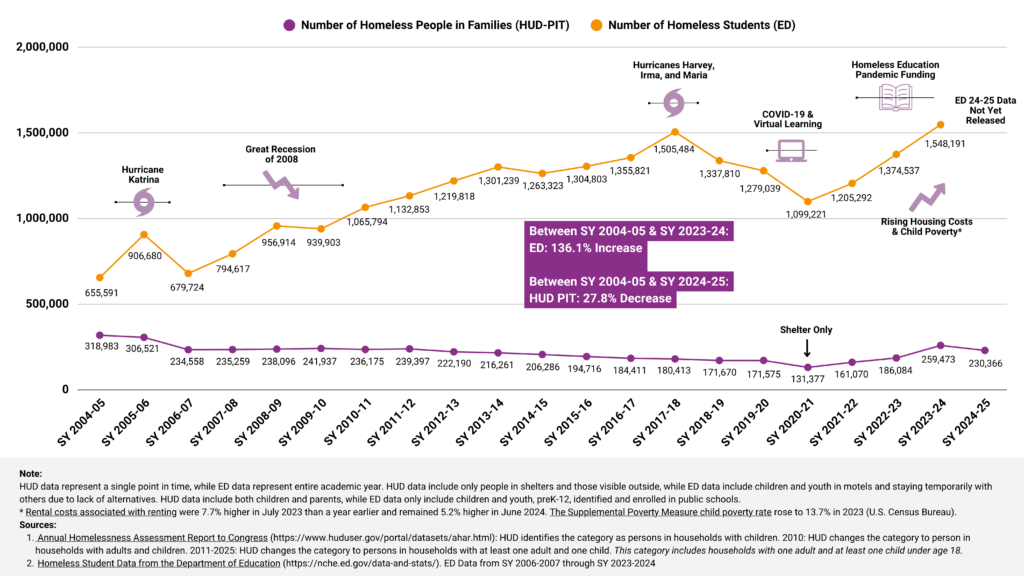
Consider the charts below: Between school years 2004-05 and 2023-24, HUD data show an 18.7% decrease in family homelessness, while public school data show a 136.2% increase. More than 80 percent of the children and youth that schools identify as homeless — those in motels, staying with others temporarily, or otherwise hidden — don’t meet HUD’s definition of homelessness and simply don’t appear in its data.
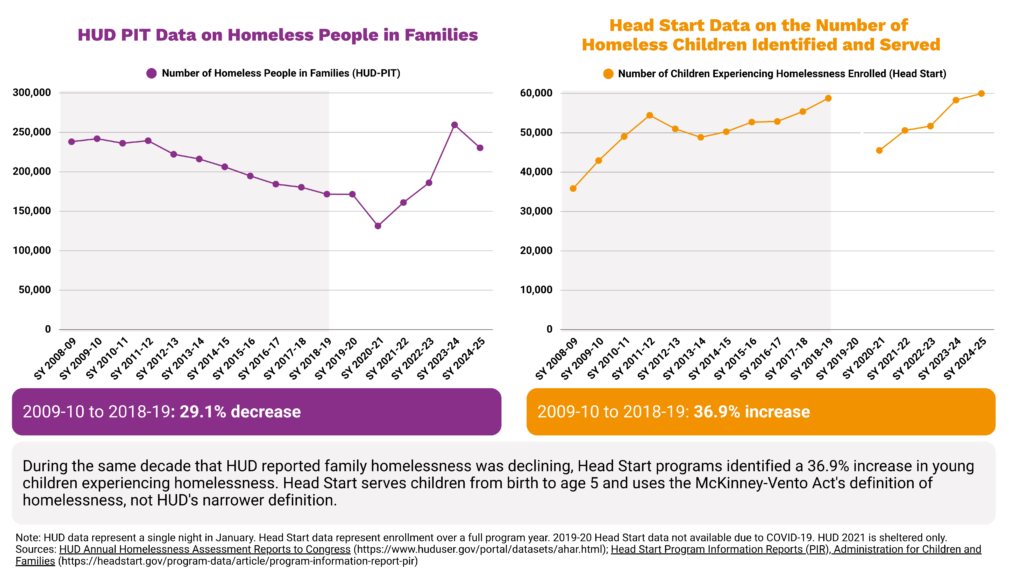
Another child-serving federal program shows a similar trend: between school years 2009-10 and SY 2018-19, HUD data show a 29.1% decrease in people in families who meet its definition, while Head Start data show a 36.9% increase in the number of homeless children identified and served.
Public school data also show marked fluctuations over time in response to external events such as natural disasters, economic crises, the pandemic, and pandemic-related aid, while for the most part HUD homeless data do not – in part because the HUD PIT count is simply measuring the capacity of shelters and the ability of volunteers to “find” people who appear to be unsheltered. Even so, public school data understate the true scale of child and youth homelessness: research consistently finds that many homeless students are never identified by schools, and infants, toddlers, and young children not yet in school are largely absent from any federal count.[1]
Thus, when advocates, media, and policymakers proclaim “progress” in reducing homelessness by citing the PIT data – and make policy recommendations based on what they think the data show – they make children and youth invisible and disregard the well-being of our nation’s youngest people experiencing homelessness. The cost of doing so is high: child and youth homelessness is correlated with a wide range of harms and risks – including continued homelessness as adults.[2]
How Policy Choices Shaped the Data
Yet some media, advocates, and policymakers uncritically use the HUD PIT data to reinforce the very policy choices that shaped it. HUD systematically shifted funding away from transitional housing toward rapid rehousing — as a result, transitional housing beds fell by 60 percent nationally between 2007 and 2025, a loss of more than 127,000 beds. People in transitional housing are counted as homeless in the PIT, while people in rapid rehousing are not. Thus, as that shift happened, families fell out of the PIT count. The apparent decline was then cited as evidence that the approach was working. But public school data and Head Start data tell a different story: while the PIT count for families fell, schools and early childhood programs identified steadily increasing numbers of homeless children throughout the same period. The data didn’t show that families and youth were becoming less homeless; they showed that the system had reclassified them.
A Decline in Numbers Isn’t Always Progress
There is another critical point frequently missed by media, advocates, and policymakers: declines in numbers of homeless children and youth reflected in the PIT count do not necessarily mean that progress has been made. Homeless children and youth must first be identified in order to receive the protections and services they need to thrive – and to decrease their risk of experiencing homelessness as adults. That’s why public schools and early childhood programs are required to conduct outreach and training, coordinate with other agencies, and widely disseminate public notice of rights and services. That is also why we at SchoolHouse Connection don’t automatically decry increasing numbers of children and youth experiencing homelessness reported by schools or early childhood programs: if agencies report higher homelessness numbers because of better identification, that is evidence of impact and progress – not failure. Conversely, a decrease in homeless numbers doesn’t necessarily mean progress in reducing homelessness. It also can mean lack of outreach, lack of capacity, failure to prioritize funding for homeless children and youth, or state and local policy choices. Massachusetts, for example, reported a 7 percent reduction in family homelessness in the most recent AHAR – but CoCs there attributed the drop to fewer shelter beds, stricter eligibility rules, and shorter length-of-stay limits, not to families actually being safely and securely housed.
All homelessness data have limitations — including school and early childhood data. But when media, advocates, and policymakers use a data source that systematically excludes a population that is particularly harmed by homelessness and that is least able to advocate for itself, the consequences can be devastating.
Who’s Missing from the Count
Public schools identified more than 1.5 million homeless children and youth last year. An estimated 446,996 infants and toddlers experienced homelessness in the 2022-23 program year. And at least 1.5 million college students reported experiencing homelessness in 2019 according to the National Center for Education Statistics. These numbers appear nowhere in most media coverage or policy debates on homelessness in the United States. And that means that children, youth, and families experiencing homelessness are literally written out of the story – and out of solutions.
What You Can Do
We urge readers to challenge this invisibility and insist upon the inclusion of other data sources — especially public schools, early childhood programs, and youth-serving programs — to get a fuller and more accurate picture of the prevalence of homelessness and the needs of those who experience it. This can take the form of letters to the editor that point out the discrepancies in definitions, and meetings with reporters and editorial boards, as well as local, state, and federal policymakers. We also can urge local, state, and national advocacy organizations to accurately represent all people experiencing homelessness in reports, statements, and advocacy positions. The children, youth, and families missing from HUD’s count should not be missing from our conversations – and our actions.
Four Bipartisan Actions Congress Can Take to Address Family and Youth Homelessness
- Pass the Homeless Children and Youth Act. The Homeless Children and Youth Act (HCYA) is bipartisan legislation that amends HUD’s definition of homelessness to align it with federal definitions of homelessness for children and youth. It will remove barriers, streamline assistance, leverage resources, and bring greater visibility to the reality of family and youth homelessness.
- Provide flexible funding to equip early childhood development programs and public schools to provide housing-related services directly to families and youth, including utilities, short-term rental assistance, motel stays, and housing location services. Bipartisan legislation like the Emergency Family Stabilization Act provides one example of one kind of legislative vehicle to accomplish this.
- Pass the Family Stability and Opportunity Vouchers Act. This bipartisan bill would create an additional 250,000 housing vouchers over five years for low-income, high-need families with young children. Pregnant women and families with a child under age 6 would qualify for these new vouchers if they have a history of homelessness or housing instability, live in an area of concentrated poverty, or are at risk of being pushed out of an opportunity area. This legislation is especially important in light of extraordinarily high rates of homelessness among infants and toddlers, and other young children. In order to reach families most directly and without bureaucratic referral systems, housing agencies should work directly with early childhood programs like Head Start and public schools, rather than through HUD’s coordinated entry system.
- Pass the Runaway and Homeless Youth and Trafficking Prevention Act, (S.3125/H.R. 6041). This legislation will comprehensively update and reauthorize the vital Runaway and Homeless Youth Act to prevent trafficking, identify survivors, and provide housing and service options to youth in need.
Footnotes
[1] Shephard, D.D., Hall, C.C., & Lamberton, C. (2021). Increasing identification of homeless students: An experimental evaluation of increased communication incorporating behavioral insights, Educational Researcher, 50(4), 239–248. https://doi.org/10.3102/0013189X20981067
[2] Clark, R.E., Weinreb,L., Flahive, J.M., Steifert, R.W. (2019). Infants exposed to homelessness: Health, health care use, and health spending from birth to age six. Health Affairs, 38(5), 721-728. https://doi.org/10.1377/hlthaff.2019.00090; Manfra, L. (2018). Impact of homelessness on school readiness skills and early academic achievement: A systematic review. Early Childhood Education Journal, 47, 239-249. https://doi.org/10.1007/s10643-018-0918-6; Cohen-Cline, H., Jones, K., & Vartanian, K. (2021). Direct and indirect pathways between childhood instability and adult homelessness in a low-income population. Children and Youth Services Review, 120. https://doi.org/10.1016/j.childyouth.2020.105707