
The Pitfalls of HUD’s Point-in-Time Count for Children, Youth, and Families
In this brief, we explain why HUD’s data are flawed and misleading, and why other federal data sources provide a more accurate picture of child, youth, and family homelessness.
On May 29, 2026, the U.S. Department of Housing and Urban Development (HUD) released its 2025 Annual Homeless Assessment Report Part I (AHAR).
This brief describes the limitations of HUD’s Point-in-Time count, and contrasts HUD’s homelessness data with other federal homelessness data. It recommends that policymakers and the public look to a variety of other data sources — especially public schools, early childhood programs, and youth-serving programs — to get a fuller and more accurate picture of the prevalence of homelessness and the needs of those who experience it. We urge federal, state, and local government to:
- Remove barriers to existing homeless assistance for families and youth;
- Create new targeted housing and service supports; and
- Provide flexible funding directly to child- and youth-serving agencies to help meet housing and related needs of children, youth, and families.
HUD’s Data and Methodology Account for Only a Fraction of Children, Youth, and Families Experiencing Homelessness, Excluding Many of the Most Vulnerable.
The Annual Homeless Assessment Report Part I (AHAR) provides estimates of people who are in shelter and in unsheltered locations on a single night. These counts, known as the Point-in-Time (PIT) counts, are conducted by communities nationwide, and typically occur during the last week in January of each year. HUD’s “Point in Time” (PIT) count only measures the number of people who are in shelter or transitional housing, or who are seen during street counts.
However, most families and youth who are homeless do not stay in shelters, transitional housing, or on the streets.
- Of the over 1.5 million children and youth experiencing homelessness identified by public schools in the 2023-2024 school year (the most recent year for which national data is available), only 4.4% were unsheltered, and 12.7% were staying in shelters. The rest were staying in motels, or staying temporarily with other people due to lack of alternatives. This invisible and unstable homelessness is not included in HUD’s limited methodology. (SHC Analysis: Six key trends from the latest federal data on identification, attendance, graduation, and more.)
- Missed Opportunities: Youth Homelessness in America found that of the 3.5 million 18-24 year-olds and 700,000 13-17 year-olds who experienced homelessness, nearly three quarters who slept on the streets or in shelters also ‘couch-surfed’ (stayed with others), demonstrating the fluid nature of homeless living arrangements.
Lack of Appropriate Shelter Options, Fear of Child Welfare Authorities, and Concern About the Safety of Shelters Explain Why Most Families and Youth Who are Homeless are Not in Shelters or on the Streets.
- Shelters and transitional housing are often full, unable to serve families as a unit, do not accept unaccompanied minor youth, or simply do not exist in too many communities. When families and youth are not able to access shelter, they are less likely to be included in HUD’s counts.
- Families experiencing homelessness are also less likely than single adults to stay on the streets and other outdoor locations where they can be included in PIT counts, often because they are afraid their children will be removed from their custody. Unaccompanied youth experiencing homelessness fear interactions with authorities and exploitation from older adults whether in a shelter, on the street, or staying on someone’s couch.
- For these reasons, families and youth are much more likely to stay temporarily with other people, or in motels — situations that are themselves very unstable, often unsafe, and put them at risk of trafficking. They are also more common in rural and suburban areas, where the PIT count results in dramatic under-counts.
Children and Youth Experiencing Homelessness Who Are Excluded from HUD’s Definition of Homelessness and its Data Are As Vulnerable as Those Who Are Included.
- Two studies of Centers for Disease Control and Prevention data show that high school students experiencing homelessness are at high risk of harm regardless of where they sleep. A 2019 study demonstrated dire risk of rape, assault, suicide, substance abuse, hunger, bullying and other risks, whether high school students experiencing homelessness are sleeping in a motel, a car, a shelter, temporarily with other people, or moving so frequently that they cannot identify a usual sleeping arrangement over a thirty-day period. Vulnerability to these harms was comparable across different homeless situations. A 2022 study found that high school students who reported homelessness had 208% higher odds of sexual victimization and 347% higher odds of physical victimization. Each homeless sleeping location, including staying with others and motels, was associated with increased odds of experiencing both sexual and physical victimization compared to sleeping at a parent or guardian’s home, underscoring the vulnerability of all high school students who experience homelessness, regardless of where they sleep.
- Four studies (California, Louisiana, Minnesota, and Washington state) find that children and youth who stay with other people temporarily, or in motels — considered homeless under the education definition — have comparable or worse educational risks and outcomes as those who stay in shelters or are unsheltered.
School and Early Childhood Data Show Different Trends in Family and Youth Homelessness
Between school years 2004-05 and 2023-24, HUD data show an 18.7% decrease in people in families who meet its definition of homelessness (in shelters or visibly counted outside).Over that same time period, public school data show a 136.1% increase in children and families who meet the federal education definition of homelessness (shelters, motels, unsheltered, and staying temporarily with others).
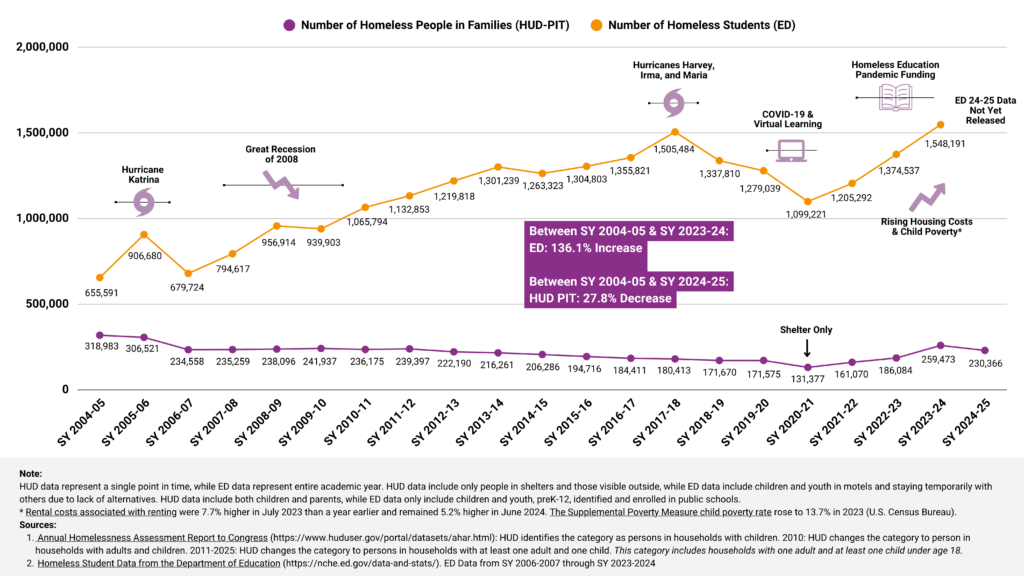
Public schools are required to proactively identify all children and youth experiencing homelessness — those who meet HUD’s definition of homelessness, and those who do not — in order to ensure that they receive educational protections and services. While there may not be a shelter bed or housing unit for every family and youth who needs one, there is a guaranteed seat in the classroom. Even with well documented challenges in the identification of homeless children and youth by schools, public schools are still much more accurate barometers of family and youth homelessness than HUD data.
A similar trend is apparent when comparing HUD data and Head Start data. Between school years 2009-10 and SY 2018-19, HUD data show a 29.1% decrease in people in families who meet its definition, while Head Start data show a 36.9% increase in the number of homeless children identified and served. Head Start programs are required to proactively identify and conduct outreach to children experiencing homelessness, and remove barriers to enrollment.
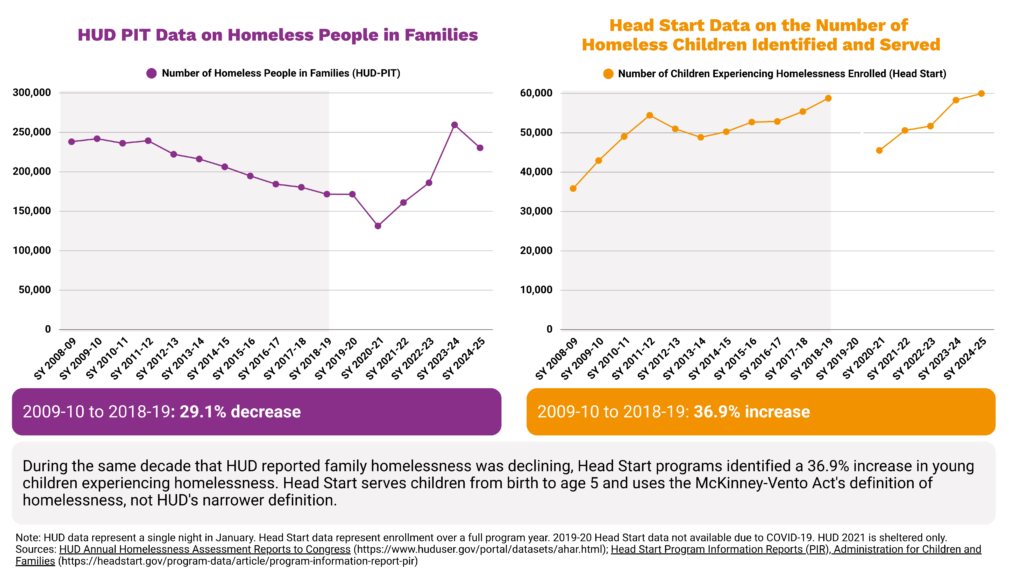
Taken together, school and Head Start data tell a consistent story: family and youth homelessness has grown substantially over the past two decades. HUD data tell the opposite story – not because family and youth homelessness has declined, but because HUD’s methodology excludes them.
HUD’s Flawed Data Contribute to Harmful Policies and Conflict with Other Agencies’ Missions and Mandates.
By underestimating family and youth homelessness, HUD data contribute to decreased attention, focus, and funding for family and youth programs and initiatives.
The reliance of policymakers on HUD homelessness data also undermines the work of, public schools and federal early childhood programs. These agencies are required to improve the identification of children and youth experiencing homelessness in order to ensure that they receive federally-mandated protections and services. Congress specifically amended the education subtitle of the McKinney-Vento Act in the Every Student Succeeds Act (ESSA) to improve the identification of homeless children and youth. The Head Start Act and the Child Care and Development Block Grant Act also include requirements for proactive outreach, identification, and enrollment of homeless children. These requirements are particularly important in light of research demonstrating that not completing high school is the greatest single risk factor for experiencing homelessness as a young person.
Communities and Policymakers Should Look To Other Data Sources To Get A Fuller And More Accurate Picture Of Homelessness
In light of the shortcomings of the PIT count, communities should look to a variety of other data sources — especially public schools, early childhood programs, and youth-serving programs — to get a fuller and more accurate picture of the prevalence of homelessness and the needs of those who experience it.
- SchoolHouse Connection and Poverty Solutions at the University of Michigan have created searchable data profiles using U.S. Department of Education and Office of Head Start data. These profiles make available child and youth homelessness data at the national, state, county, school district, and Congressional levels.
- Missed Opportunities: Youth Homelessness in America, remains the most comprehensive and reliable data sources on unaccompanied youth experiencing homelessness, ages 13-25.
- Researchers at the Chicago Coalition for the Homeless (CCH), Vanderbilt University, and the Heartland Alliance Social IMPACT Research Center developed a census-based model for estimating doubled-up homelessness across the United States. Research on this peer-reviewed methodology was published in Housing Policy Debate in January 2022. Using this method, researchers found that 3.7 million people in the U.S. population were doubled-up in 2019. First used to provide a comprehensive homeless estimate in Chicago in 2016, CCH continues to release an annual count of Chicago’s homeless population each year. CCH also leads a Homelessness Data Project that seeks to expand a model, and has developed a toolkit to train organizations and advocates on how to conduct a comprehensive homeless estimate in their region. The goal is to build a more accurate snapshot of what homelessness looks like across the country, while also building a base committed to aligning HUD’s definition of homelessness to include people staying in doubled-up situations.
Federal and State Policymakers Should Remove Barriers to Homeless Assistance Caused by Restrictive Definitions
Congress should take action to remove barriers caused by HUD’s restrictive and complicated definition of homelessness by:
- Enacting the bipartisan Homeless Children and Youth Act, which aligns the HUD definition of homelessness with those served by other federal agencies and programs serving children, youth, and families.
- Providing flexible funding directly to child- and youth-serving agencies to help meet housing and related needs of children, youth, and families, including through legislation like the bipartisan Emergency Family Stabilization Act.
- Enacting the Family Stability and Opportunity Vouchers Act. This bipartisan bill would create an additional 250,000 housing vouchers over five years for low-income, high-need families with young children. Pregnant women and families with a child under age 6 would qualify for these new vouchers if they have a history of homelessness or housing instability, live in an area of concentrated poverty, or are at risk of being pushed out of an opportunity area. This legislation is especially important in light of extraordinarily high rates of homelessness among infants and toddlers, and other young children. In order to reach families most directly and without bureaucratic referral systems, housing agencies should work directly with early childhood programs like Head Start and public schools, rather than through HUD’s coordinated entry system.
State policymakers should ensure that state-funded homeless assistance programs adopt a broader definition of homelessness that is aligned with the federal early care and education definition. States also should consider flexible funding that goes directly to child- and youth-serving agencies, rather than HUD Continuums of Care, to meet the comprehensive needs of families and youth experiencing homelessness.