ACF’s proposed Head Start rule eliminates the policies protecting children experiencing homelessness. SchoolHouse Connection’s in-depth analysis breaks down what’s at stake and how to weigh in by Oct. 6.

Early Childhood, Federal Policy (August 2026)
Proposed Head Start Rule Eliminates Critical Protections for Children Experiencing Homelessness
On August 7, 2026, the Administration for Children and Families (ACF) at the U.S. Department of Health and Human Services proposed to rescind and replace the Head Start Program Performance Standards; public comments are due October 6, 2026. The proposed rule would repeal the regulations that carry out the Head Start Act’s requirements to remove barriers to enrollment for children experiencing homelessness.
What’s at Stake
Families experiencing homelessness face barriers to Head Start that are above and beyond those of other low-income families. They move without warning, often across school district and service area lines; they lose access to paperwork, phones, and wifi. Most stay in hidden, fluid situations – temporarily with other people or in motels, rather than in shelters – and this is especially true in rural and suburban areas. These living arrangements make outreach and identification difficult. The shame and stigma associated with homelessness means that families rarely self-identify and are often hesitant to ask for help.
For a young child with no home, Head Start may be the only stable, predictable place in life – the only setting where a developmental delay is caught early or a meal provided. Infants and toddlers experience homelessness during the fastest period of brain development, when consistent caregiving and predictable routines matter most. Early Head Start provides both. Head Start and Early Head Start also connect parents to employment, education, health services, and housing, helping to create permanent paths out of homelessness and into economic stability.
What the Law Requires
In 2007, in recognition of the barriers faced by families experiencing homelessness – and the promise of Head Start in breaking the cycle – Congress wrote into the Head Start Act itself requirements that the U.S. Department of Health and Human Services issue rules to “establish policies and procedures to remove barriers to the enrollment and participation of homeless children in Head Start programs.” Congress spelled out in the statute exactly what those administrative policies and procedures must require:
- Programs must identify children experiencing homelessness and prioritize them for enrollment;
- Programs must allow families experiencing homelessness to apply, enroll, and attend while required documents, like birth certificates and immunization records, are obtained; and
- Programs must coordinate with the McKinney-Vento liaisons in local educational agencies.
What the Proposed Rule Changes
The current Head Start rules carry out all three requirements to varying degrees. The proposed rule repeals every one of them and replaces them with a single sentence: children experiencing homelessness “qualify for program eligibility and must be treated in accordance with the Head Start Act.” Proposed § 1301.02(g).
Why the Statute Alone Is Not Enough
Section 640(m) is not self-executing. The statutory provision protects children experiencing homelessness only through the administrative rules the Secretary is required to issue. Those rules determine whether children are found, whether they can enroll before their records arrive, and whether a slot is held for them if they move mid-year.
Congress also chose its words carefully. Section 640(m) directs the Secretary to issue rules establishing “policies and procedures” to remove barriers, and mandates that those rules shall require agencies “to implement policies and procedures” ensuring identification and prioritization. Policies set out what a program must do; procedures set out how it must do it. Congress required both policies and procedures to ensure that the statutory requirements were actually implemented. Yet the proposed rule provides neither policies nor procedures for ensuring the identification and prioritization of homeless children.
The preamble of the Notice of Proposed Rule Making (NPRM) acknowledges the underlying duty, stating that programs “must still comply with the statutory requirement to support enrollment of children experiencing homelessness.” But preamble language binds no one. And, as noted, the statutory requirement directs the Secretary to provide specific policies and procedures for carrying out the statutory mandate. With those policies and procedures stripped out of the regulations, the proposed rule imposes no requirement on any program, and it leaves federal reviewers nothing to examine on behalf of the children the statute protects. The chart below sets out each provision that would be removed, with the current regulatory text, so that readers can see precisely what is lost.
What the Current Rules Have Achieved
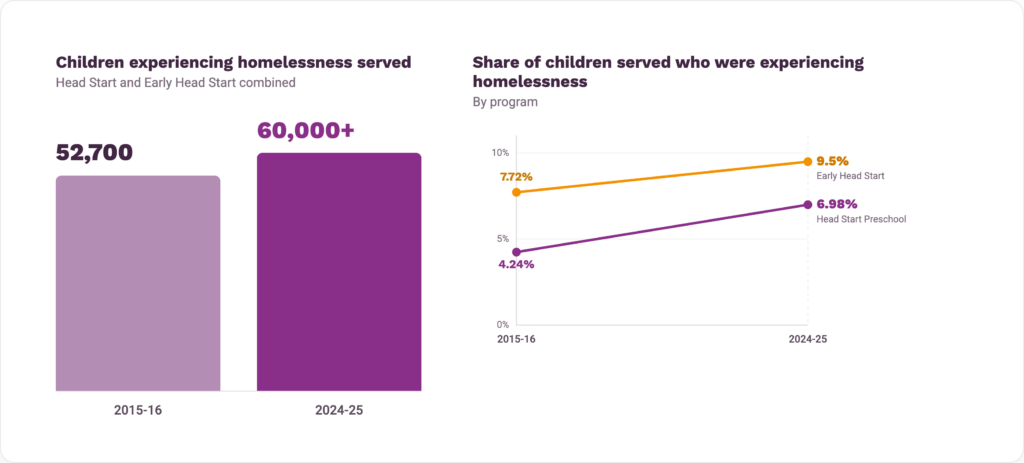
In the 2024-25 program year, Head Start and Early Head Start served more than 60,000 children experiencing homelessness, the highest number on record, up from about 52,700 in 2015-16. Over the same period, total Head Start enrollment declined, so children experiencing homelessness also grew as a share of those served, from 4.24 percent to 6.98 percent in Head Start Preschool and from 7.72 percent to 9.5 percent in Early Head Start.1 Those are the children this rule puts at risk.
Other Changes in the Proposed Rule
SchoolHouse Connection recognizes that the proposed changes to teacher qualifications, ratios, group size, and health and safety standards also will affect children experiencing homelessness, who depend on the quality and stability of Head Start at least as much as any other group of children – as will the reduction of the administrative cost cap from 15 percent to 5 percent, since identifying families, determining eligibility, and maintaining community partnerships all take staff time. Other organizations are analyzing those provisions in depth. SchoolHouse Connection’s analysis and comments will focus on the provisions that determine whether children experiencing homelessness can enroll and participate in Head Start at all.
Deferring to States Does Not Remove Barriers For Children Experiencing Homelessness
The NPRM’s organizing rationale is deference to states, but with respect to the policies of greatest impact for children experiencing homelessness – identification, enrollment, attendance, and McKinney-Vento coordination – there is either no state law to defer to or deference would impose (or reimpose) the very barriers that Congress wished to remove. For example, current § 1302.15(e) exempts children experiencing homelessness from state immunization enrollment requirements, but the proposed rule removes that exemption; as a result, state documentation law would apply without exception, restoring the exact barrier that Section 640(m)(2) directs the Secretary to remove. Deference to fifty often-varying state rules also would have a disproportionately negative impact on homeless families who often cross service areas and state lines, and it would be inconsistent with a PreK-12 system in which every local educational agency in the country must enroll a child experiencing homelessness immediately, without records, under the McKinney-Vento Act. SchoolHouse Connection will address the state deference rationale, including ACF’s federalism certification under Executive Order 13132, in detail in our forthcoming formal comments.
What Comes Next
SchoolHouse Connection will submit formal comments before the October 6 deadline, informed by what we hear from our network of Head Start and Early Head Start programs, Head Start State Collaboration Offices, local homeless service providers, school district homeless liaisons, and parents. Streamlining the Performance Standards overall may be a legitimate goal, and we have supported changes in past rulemakings. But the regulations carrying out Section 640(m) must be specific enough that a program knows what to do and a monitor can check whether it was done. That will be the focus of our comments.
Organizations developing their own comments are welcome to use or adapt any part of SHC’s analysis.
SHC has prepared two sets of materials you can use to provide comments:
- One for people who are commenting mostly about homelessness, and
- One for people who are commenting mostly on other aspects of the rule, but wish to include homelessness.
Please contact Barbara Duffield with any questions or comments.
How to Read the Chart Below
The following chart compares the statute, the current regulation, and the proposed rule. Where the elimination of a current regulation is most consequential, the third column quotes the current regulatory text rather than describing it. Every obligation in the second column is written into the Head Start Act and remains binding on HHS, regardless of the outcome of this rulemaking. The chart also includes children in foster care, whose eligibility rests on a different legal foundation, for comparison.
Children Experiencing Homelessness (Statute, Current Regulation, and Proposed Rule Compared)
Definition of homeless children
What the Head Start Act Requires: “The term ‘homeless children’ has the meaning given the term ‘homeless children and youths’ in section 725(2) of the McKinney-Vento Homeless Assistance Act.” Sec. 637(11), 42 U.S.C. 9832(11). Section 725(2) of the McKinney-Vento Act, in turn, covers children who “lack a fixed, regular, and adequate nighttime residence,” including children “sharing the housing of other persons due to loss of housing, economic hardship, or a similar reason; . . . living in motels, hotels, trailer parks, or camping grounds due to the lack of alternative adequate accommodations; . . . living in emergency or transitional shelters,” and children “living in cars, parks, public spaces, abandoned buildings, substandard housing, bus or train stations, or similar settings.” 42 U.S.C. 11434a(2).
| Current Regulation (2024 HSPPS) | Status in the 2026 Proposed Rule |
| “Homeless children means the same as homeless children and youths in Section 725(2) of the McKinney-Vento Homeless Assistance Act at 42 U.S.C. 11434a(2).” § 1305.2 | The definition is removed from regulation. The NPRM’s definitions table marks it “Term defined in statute – Removed.” Because the definition is in the Act, it cannot be narrowed or removed by regulation. Impact: Program staff work from the Performance Standards, not the U.S. Code. The definition matters because it is broader than the everyday meaning of “homeless”: it covers families staying temporarily with others, in motels, and in cars — the situations that are the most common for families experiencing homelessness, and the ones program staff are least likely to recognize without the definition in front of them. Removing the definition from regulation invites eligibility decisions based on stereotypes and misunderstandings of family homelessness. |
Categorical eligibility
What the Head Start Act Requires: “[H]omeless children shall be deemed to be eligible” for Head Start. No income test applies. The Act directs that the Secretary’s eligibility regulations “shall provide” this. Sec. 645(a)(1)(B)(ii), 42 U.S.C. 9840(a)(1)(B)(ii).
| Current Regulation (2024 HSPPS) | Status in the 2026 Proposed Rule |
| Standalone eligibility category at § 1302.12(c)(1)(iii): “The child is homeless, as defined in part 1305.” Verification at § 1302.12(i)(3): “To verify whether a family is homeless, a program may accept a written statement from a homeless services provider, school personnel, or other service agency attesting that the child is homeless or any other documentation that indicates homelessness, including documentation from a public or private agency, a declaration, information gathered on enrollment or application forms, or notes from an interview with staff to establish the child is homeless; or any other document that establishes homelessness.” § 1302.12(i)(3) “If a family cannot provide one of the documents described in this paragraph (i)(3) to prove the child is homeless, a program may accept the family’s signed declaration to that effect, if, in a written statement, program staff describe the child’s living situation that meets the definition of homeless in part 1305 of this chapter.” § 1302.12(i)(3)(ii) | Categorical eligibility is retained at proposed § 1301.02(g). The verification menu and the signed-declaration pathway are both rescinded, and proposed § 1301.02(c)(4) states that self-attestation does not satisfy eligibility. The eligibility category itself is statutory and cannot be removed by regulation; the means of establishing it are what the rule withdraws. Impact: A family who fled domestic violence in the middle of the night, or who is moving from place to place, often has no shelter letter and no agency record. The signed declaration might be the only way a child who is eligible under the Act can actually enroll. The rule removes that pathway and separately prohibits self-attestation. |
Secretary’s duty to issue rules removing barriers to enrollment and participation
What the Head Start Act Requires: “The Secretary shall issue rules to establish policies and procedures to remove barriers to the enrollment and participation of homeless children in Head Start programs.” The rules “shall require” agencies to carry out the three duties in the rows below. Sec. 640(m), 42 U.S.C. 9835(m).
| Current Regulation (2024 HSPPS) | Status in the 2026 Proposed Rule |
| Implemented across Part 1302 Subpart A (eligibility, recruitment, selection, enrollment, attendance) and § 1302.53 (partnerships). | The implementing provisions are removed or replaced as detailed below. The preamble acknowledges the mandate, stating programs “must still comply with the statutory requirement to support enrollment of children experiencing homelessness.” Section 640(m) is a directive to the Secretary and reaches programs only through rules, so an acknowledgment in a preamble, which is not part of a rule, does not discharge the Secretary’s obligation. |
Identification and prioritization (Sec. 640(m)(1))
What the Head Start Act Requires: The Secretary’s rules shall require agencies “to implement policies and procedures to ensure that homeless children are identified and prioritized for enrollment.” Sec. 640(m)(1).
| Current Regulation (2024 HSPPS) | Status in the 2026 Proposed Rule |
| “A program must include specific efforts to actively locate and recruit children with disabilities and other children in need, including children experiencing homelessness and children in foster care.” § 1302.13 “A program must annually establish selection criteria that weigh the prioritization of selection of participants, based on community needs identified in the community needs assessment . . . and including family income, whether the child is homeless, whether the child is in foster care, the child’s age . . . .” § 1302.14(a)(1) “If a program determines from the community assessment there are families experiencing homelessness in the area, or children in foster care that could benefit from services, the program may reserve one or more enrollment slots for pregnant women and children experiencing homelessness and children in foster care, when a vacancy occurs. No more than three percent of a program’s funded enrollment slots may be reserved. If the reserved enrollment slot is not filled within 30 days, the enrollment slot becomes vacant and then must be filled in accordance with paragraph (a) of this section.” § 1302.15(c) | Sections 1302.13 and 1302.14 are removed with no counterpart in proposed Part 1301, and the reserved slots provision is eliminated with the replacement of § 1302.15. The proposed regulation contains no provision requiring any program to locate, identify, or prioritize a child experiencing homelessness. The preamble states that programs “would no longer be required to develop and implement a recruitment process” and assumes programs will tailor recruitment on their own. Note: ACF concedes in the regulatory impact analysis that “there may be costs to children and families from the removal of the requirement that programs . . . recruit specific populations.” Impact: Because most families experiencing homelessness stay in hidden situations and rarely self-identify, enrollment depends on programs actively looking for them. The rules that would be eliminated by the NPRM work in concert: the community assessment gives a program the number of children experiencing homelessness in its service area, the annual selection criteria require the program to weigh that need, and reserved slots allow the program to hold a seat for these children when a vacancy occurs. Reserved slots matter because homeless families in crisis arrive in every month of the year, and they often move again before reaching the top of a waiting list. The current rule sets limits on this authority: no more than three percent of funded enrollment may be reserved, and a reserved slot that is not filled within 30 days reverts to a general vacancy. The proposed rule keeps the 30-day fill requirement at proposed § 1301.03(c) but deletes the limited exception that made reservation possible. A program that has been informed about a family in a shelter and that holds a seat for the family would be in violation of the rules, with nothing in regulation permitting the program to hold the slot. Under the proposed rule, a program that never counts homeless children, never weighs them in selection, and never holds a seat for them would violate no regulation. |
Enrollment and attendance while documents are obtained (Sec. 640(m)(2))
What the Head Start Act Requires: The Secretary’s rules shall require agencies “to allow families of homeless children to apply to, enroll in, and attend Head Start programs while required documents, such as proof of residency, immunization and other medical records, birth certificates, and other documents, are obtained within a reasonable time frame.” Sec. 640(m)(2).
| Current Regulation (2024 HSPPS) | Status in the 2026 Proposed Rule |
| If a program determines a child is eligible under §1302.12(c)(1)(iii), it must allow the child to attend for up to 90 days or as long as allowed under state licensing requirements, without immunization and other records, to give the family reasonable time to present these documents.” § 1302.16(c)(1) “A program must comply with state immunization enrollment and attendance requirements, with the exception of homeless children as described in §1302.16(c)(1).” § 1302.15(e) “If a child experiencing homelessness is unable to attend classes regularly because the family does not have transportation to and from the program facility, the program must utilize community resources, where possible, to provide transportation for the child.” § 1302.16(c)(2) | All of these provisions are removed with no counterpart in proposed Part 1301, along with the flexible verification at § 1302.12(i)(3). The preamble restates the Section 640(m) requirement, including the “reasonable time frame” language, without carrying it into regulatory text. Because § 1302.15(e) is the express exception to state immunization enrollment law, its removal means state documentation requirements would apply to children experiencing homelessness without exception. The statute names immunization and medical records among the documents that cannot function as enrollment barriers. Impact: Families lose documents in the course of losing housing and repeated moves. Requiring documents before a child can start creates barriers: the child waits, and mobile families often lose contact with the program before the process concludes. Congress named these documents in the statute, including birth certificates and immunization records, because they were the barriers programs most often imposed. |
McKinney-Vento coordination (Sec. 640(m)(3))
What the Head Start Act Requires: The Secretary’s rules shall require agencies “to coordinate individual Head Start programs with efforts to implement subtitle B of title VII of the McKinney-Vento Homeless Assistance Act.” Sec. 640(m)(3).
| Current Regulation (2024 HSPPS) | Status in the 2026 Proposed Rule |
| A program must establish collaborative relationships and partnerships with “Housing assistance agencies and providers of support for children and families experiencing homelessness, including the local educational agency liaison designated under section 722(g)(1)(J)(ii) of the McKinney-Vento Homeless Assistance Act (42 U.S.C. 11431 et seq.).” § 1302.53(a)(2)(vi) The community assessment must include demographic data on “Children experiencing homelessness in collaboration with, to the extent possible, McKinney-Vento Local Education Agency Liaisons (42 U.S.C. 11432(6)(A)).” § 1302.11(b)(2)(i)(C) | Both provisions are removed with no counterpart in proposed Part 1301. The proposed regulatory text does not reference McKinney-Vento coordination anywhere. The preamble names McKinney-Vento only as an example of applicable law for attendance procedures under proposed § 1301.03(b). Impact: Federal law already requires every school district homeless liaison to identify preschool-age children and refer them to Head Start and other early childhood programs; the removed regulations were the reciprocal requirement for Head Start programs. Liaisons know which families are staying with others, which are in motels, and which have children under five, because they enroll the school-age siblings. As a result, school district liaisons identify more infants and toddlers experiencing homelessness than any early childhood program serves. A Head Start program disconnected from its homeless liaison loses its most reliable source of referrals, and the community assessment loses the only local count of these children. Coordination must occur on both the Head Start and the school side. |
Continuity of enrollment when a family moves
What the Head Start Act Requires: No express statutory counterpart. This provision implements the Section 640(m) barrier-removal mandate in the circumstance that defines homelessness, which is instability of residence.
| Current Regulation (2024 HSPPS) | Status in the 2026 Proposed Rule |
| “If a program serves homeless children or children in foster care, it must make efforts to maintain the child’s enrollment regardless of whether the family or child moves to a different service area, or transition the child to a program in a different service area, as required in §1302.72(a), according to the family’s needs.” § 1302.15(b)(3) | Removed, along with § 1302.72(a). Nothing in proposed Part 1301 addresses what happens to a child experiencing homelessness whose family moves during the program year. Under a state-deference approach, a family that crosses a service area or state line would encounter a different set of rules on arrival. Impact: Children experiencing homelessness move frequently. Under the proposed rule, a child could lose a Head Start slot at the moment of greatest instability, and the family would start over at the bottom of a waiting list in the new community. |
Community assessment of homelessness
What the Head Start Act Requires: In allocating certain funds the Secretary considers the extent of community wide strategic planning involving the McKinney-Vento LEA liaison and agencies providing “services for homeless children,” and the extent of coordination with the local educational agency including that liaison. Sec. 640(g)(1)(C) and (H), 42 U.S.C. 9835(g)(1)(C), (H).
| Current Regulation (2024 HSPPS) | Status in the 2026 Proposed Rule |
| Community assessment data on children experiencing homelessness, in collaboration with McKinney-Vento LEA liaisons, at § 1302.11(b)(2)(i)(C); annual review and update at § 1302.11(b)(5). | Section 1302.11 is removed in its entirety, so no program would be required to count children experiencing homelessness in its community or to consult the liaison who has that count. The statutory grant criteria naming the liaison and services for homeless children remain in effect, with no regulatory mechanism generating the information they call for. Impact: A Head Start program that does not know how many children experiencing homelessness are in its service area will not adjust recruitment, slots, or partnerships to reach them. The annual review is how programs assess changes, since local homelessness can spike quickly after evictions, disasters, or economic shocks. The data this requirement draws on already exists in every school district, because liaisons are federally required to collect it, so the requirement’s burden is minimal compared to what it gives programs: an accurate picture of the need in their own service area. |
Eligibility duration
What the Head Start Act Requires: A child determined eligible and participating in a program “shall be considered to continue to meet the eligibility criteria through the end of the succeeding program year.” Sec. 645(a)(1)(B)(v).
| Current Regulation (2024 HSPPS) | Status in the 2026 Proposed Rule |
| Implemented at § 1302.12(j)(1). | Removed as duplicative of statute. The statutory duration rule is unchanged and applies to children found eligible on the basis of homelessness as to all others. |
Homeless children served before over-income children
What the Head Start Act Requires: An agency using the 35 percent over-income flexibility must establish outreach and enrollment policies ensuring it meets the needs of poverty-line, public-assistance, and homeless children first, and must establish selection criteria providing that those children are served before over-income children. Sec. 645(a)(1)(B)(iii)(II)(aa) and (bb).
| Current Regulation (2024 HSPPS) | Status in the 2026 Proposed Rule |
| Implemented at § 1302.12(d)(1)(i) and (ii), by cross-reference to the eligibility categories in § 1302.12(c), which include homelessness: “Establishes criteria that ensure pregnant women and children eligible under the criteria listed in paragraph (c) of this section are served first.” § 1302.12(d)(1)(ii) | Removed. The preamble lists this among provisions removed because they are already detailed in statute. The statutory conditions on the 35 percent flexibility are unchanged and continue to bind any agency using it. |
Annual reporting on serving homeless children
What the Head Start Act Requires: An agency using the flexibility shall report annually to the Secretary on how it is meeting the needs of poverty-line, public-assistance, and homeless children, including local demographic data, outreach and enrollment policies, selection criteria, enrollment levels, disaggregated counts by eligibility category, and the waiting list. Sec. 645(a)(1)(B)(iv).
| Current Regulation (2024 HSPPS) | Status in the 2026 Proposed Rule |
| The program must be able to report “How it is meeting the needs of low-income families or families potentially eligible for public assistance, homeless children, and children in foster care, and include local demographic data on these populations.” § 1302.12(d)(2)(i) | Removed as duplicative of statute. The preamble states programs “must comply with enrollment-related reporting requirements if serving children under the 130 percent poverty line provision.” The statutory reporting duty is unchanged. |
Children in Foster Care (Statute, Current Regulation, and Proposed Rule Compared)
Eligibility
What the Head Start Act Requires: The Act does not name foster care as a standalone eligibility category. Sec. 645(a)(1)(B) names three routes: family income below the poverty line, eligibility or potential eligibility for public assistance, and homelessness. Children in foster care generally reach eligibility through the public assistance route; ACF guidance (ACF-IM-HS-22-03, cited in the NPRM preamble) treats public assistance as including TANF, SSI, and SNAP, and current § 1302.12(c)(1)(ii) names TANF child-only payments. Sec. 645(a)(1)(B)(i).
| Current Regulation (2024 HSPPS) | Status in the 2026 Proposed Rule |
| Standalone categorical eligibility at § 1302.12(c)(1)(iv) (“The child is in foster care”), with verification at § 1302.12(i)(4). Both were added to regulation in the 2016 rulemaking. | Retained. Proposed § 1301.02(b) provides that children in foster care qualify for program eligibility, and proposed § 1301.02(c)(3) carries the verification provision forward. The preamble states this represents no change in policy. ACF’s decision to preserve foster care eligibility and its verification pathway is the right one: it shows the agency recognizes that categorical eligibility works best when it is paired with a practical way to verify it. Yet the same rule withdraws that pairing for children experiencing homelessness, whose eligibility, unlike foster care’s, is written into the Act itself. The commitment ACF honors here is the same one Section 645(a)(1)(B)(ii) requires for children experiencing homelessness. |
Recruitment, prioritization, and continuity
What the Head Start Act Requires: The Act names children in foster care in several provisions, including the community wide strategic planning criterion at Sec. 640(g)(1)(C)(iv), but contains no counterpart to Section 640(m) directing the Secretary to issue rules removing barriers for this population. The grant criteria’s community wide strategic planning provision lists “foster care” among the services whose providers should be involved in planning. Sec. 640(g)(1)(C)(iv).
| Current Regulation (2024 HSPPS) | Status in the 2026 Proposed Rule |
| Community assessment data on children in foster care at § 1302.11(b)(2)(i)(D); recruitment at § 1302.13; selection weighting at § 1302.14(a)(1); continuity, reserved slots, and transitions at §§ 1302.15(b)(3), 1302.15(c), and 1302.72(a). Each of these provisions names children in foster care alongside children experiencing homelessness; the quoted text appears in the rows on homelessness above. | All listed regulatory provisions are removed. Unlike homelessness, the Act contains no foster care counterpart to Section 640(m), so these provisions rested on regulatory authority alone. The statutory planning criterion is unchanged. Impact: Reserved slots, weighted selection criteria, targeted recruitment, and continuity of enrollment apply to children in foster care through the same provisions discussed in the homelessness section above, and their removal carries the same consequences: children entering care mid-year face the same waiting-list problem, since placements happen in every month, and the same 30-day vacancy requirement at proposed § 1301.03(c) would remain with no reservation authority as an exception to it. The difference is the legal ground: because the Act contains no foster care counterpart to Section 640(m), regulation is the only place these protections for children in foster care have ever existed, and the only place they can be restored. |
Footnotes
1 SchoolHouse Connection analysis of Head Start Program Information Report data, 2007-08 through 2024-25. Head Start Program Information Report: https://headstart.gov/program-data/article/program-information-report-pir