
Data Show Dramatic Increases in Family and Youth Homelessness for the Second Consecutive Year
On December 27, 2024, the U.S. Department of Housing and Urban Development (HUD) released its 2024 Annual Homeless Assessment Report Part I (AHAR). The report shows an 18% increase in the overall number of people who were in homeless shelters or in a visibly unsheltered situation on a single night in January compared to the previous year.
For the second year in a row, the greatest increases among populations were among families with children and unaccompanied youth:
- Families with children – a 39.4% increase in 2024 (after a 16% increase in 2023)
- Unaccompanied youth – a 10% increase in 2024 (after a 15% increase in 2023)
Among all age groups, children under 18 experienced the largest single-year increase in homelessness (33%). (HUD groups all children under 18 into a single category, obscuring the significant numbers of infants, toddlers, and very young children who experience homelessness.)
The increases in homelessness among families with children and unaccompanied youth are especially concerning because HUD’s numbers represent a very small fraction of the number of children, youth, and families who experience homelessness.
When reviewing the new HUD report and media coverage, it’s important to keep four facts in mind:
1. HUD’s data are based on a “Point-in-Time” count and a very narrow definition of homelessness, and therefore exclude most children, youth, and families who experience homelessness.
HUD’s data are based on a “Point-in-Time (PIT)” count. That count is restricted to people in shelters, transitional housing, or outside on a single night in January.
But most families and youth who are homeless do not stay in shelters, transitional housing, or outside. In fact, only 16% of children and youth experiencing homelessness enrolled by public schools are in these situations when they are first identified by schools. Shelters and transitional housing are non-existent in many communities – especially rural and suburban communities – and are often full where they do exist. Shelters also may be unable to serve families as a unit, or youth under age 18 who are homeless on their own. And families and youth are less likely to stay outside because they are afraid that their children will be removed from their custody. Similarly, unaccompanied youth avoid living on the streets out of fears of interactions with authorities and exploitation from older adults.
As a result of these circumstances, most children and youth experiencing homelessness stay in motels or temporarily with other people due to lack of alternatives. Many move fluidly between these situations, which are often dangerous and highly insecure. This invisible and unstable homelessness is not included in HUD’s PIT count, but is included in definitions and data used by early childhood and education agencies.
Staying with other people temporarily or in motels is not a less damaging form of homelessness for children and youth – it is associated with educational and health harms that are comparable to the harms experienced by children and youth who are counted as experiencing HUD-defined homelessness, as reflected in the PIT count. (Read more about the pitfalls of HUD’s Point-in-Time Count.)
2. Despite HUD’s claims, family homelessness has been on the rise for many years.
HUD asserts that the increase in the number of families with children staying in shelters, or who were counted as homeless because they were visible outside, reverses a long-term decline in family homelessness. However, school data paint a different picture of the trends in family homelessness.
In order to ensure that children and youth receive educational protections and services, public schools are required to proactively identify all children and youth experiencing homelessness — those who meet HUD’s definition of homelessness, and those who do not. While there may not be a shelter bed or housing unit for every family and youth who needs one, there is a guaranteed seat in the classroom.
This means that – even with well-documented challenges to the identification of homeless children and youth by schools – public schools are still much more accurate barometers of family and youth homelessness than HUD data.
Between the 2004-05 school year and the 2022-2023 school year – public school data show a 110% increase in children and families who meet the federal education definition of homelessness (which includes those in shelters and motels, unsheltered, and staying temporarily with others). With the exception of decreases during the pandemic (attributable to school building closures and the inability to identify homeless students), and sharp increases after disasters, the overall trend has been steadily upward.
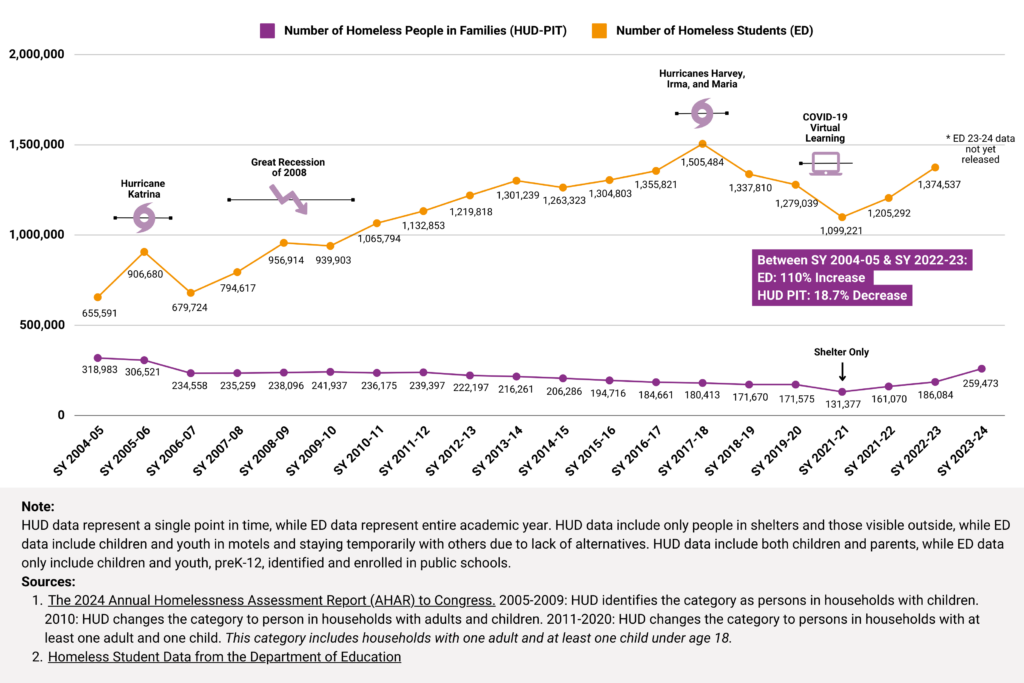
3. HUD asserts that the dramatic increase in family homelessness in 2024 was largely due to the winding down of pandemic-era relief measures and to immigration. The reality is more complicated.
In its communications about the report, HUD emphasized immigration and the end of COVID relief as the principal causes of the increases in family homelessness reflected in the report. Yet the report notes that only 13 communities reported that immigration impacted their homelessness data. Moreover, the report itself recognizes that homelessness is caused by a diverse array of factors. By cherry-picking a few factors as responsible for increasing homelessness, HUD seeks to insulate its own policy failures from scrutiny. Worse, it contributes to the demonization and scapegoating of a population that is under attack from multiple quarters.
Even more tenuous is HUD’s claim that the end of pandemic aid is responsible for increasing family homelessness. While pandemic-era measures undoubtedly kept many families in their homes, the fact remains that many families and youth experiencing homelessness were unable to benefit from these measures, and they continue to be overlooked in HUD housing and homeless programs. Eviction moratoria did little to stabilize the many families and youth who were staying temporarily with others and therefore who could be – and were – kicked out at a moment’s notice. Families and youth staying temporarily with others also weren’t prioritized for Emergency Housing Vouchers, even though they were unable to social distance in the crowded, precarious dwellings of other people.
There is a long-term trend that HUD does not highlight: fewer families also appear to be served by existing HUD resources. As outlined in this letter to HUD by U.S. Representatives Bonamici (D-OR) and McGravey (D-KY), the percentage of people with children in subsidized housing nationally has fallen to 33 percent, the lowest percentage in a decade and an overall decline of eight percent from 2010. HUD has not yet responded to this Congressional letter.
4. There is a strong correlation between childhood homelessness and adult homelessness. Yet federal homelessness policy has failed to prioritize family homelessness, or ignored it altogether.
For decades, the bulk of federal homelessness resources, attention, and energy has been directed to visibly homeless adults, including and especially those who are chronically homeless. This policy has failed: chronic homelessness is also at its highest level ever recorded. Many homeless adults first experienced homelessness as children or youth, failed to graduate from high school, and/or suffered various adverse events that impacted them throughout life. Efforts to intervene before these children and youth reached adulthood could have prevented their later bouts of more entrenched homelessness.
Federal, state, and local homelessness policies must prioritize expectant parents, families with children, and unaccompanied youth in order to reduce homelessness and improve life outcomes for all populations.
Four Bipartisan Actions Congress Can Take
The Homeless Children and Youth Act (HCYA) is bipartisan legislation that amends HUD’s definition of homelessness to align it with federal definitions of homelessness for children and youth. It will remove barriers, streamline assistance, leverage resources, and bring greater visibility to the reality of family and youth homelessness.
Early childhood development programs and public schools play a key role in identifying and assisting families and youth experiencing homelessness, regardless of where they find a place to sleep. These agencies can provide housing-related services — such as utilities, short-term rental assistance, motel stays, and housing location services — directly to families and youth directly and without bureaucratic referral processes. Bipartisan legislation like the Emergency Family Stabilization Act provides one example of a legislative vehicle to provide assistance.
This bipartisan bill would create an additional 250,000 housing vouchers over five years for low-income, high-need families with young children. Pregnant women and families with a child under age 6 would qualify for these new vouchers if they have a history of homelessness or housing instability, live in an area of concentrated poverty, or are at risk of being pushed out of an opportunity area. This legislation is especially important in light of extraordinarily high rates of homelessness among infants and toddlers, and other young children. In order to reach families most directly and without bureaucratic referral systems, housing agencies should work directly with early childhood programs like Head Start and public schools, rather than through HUD’s coordinated entry system.
This legislation will comprehensively update and reauthorize the vital Runaway and Homeless Youth Act to prevent trafficking, identify survivors, and provide housing and service options to youth in need.