
House Bill Preserves Homeless Education Funding While Cutting Overall Education Funding
This page breaks down the House FY2026 bill: impacts on EHCY, Title I, and other key education programs.
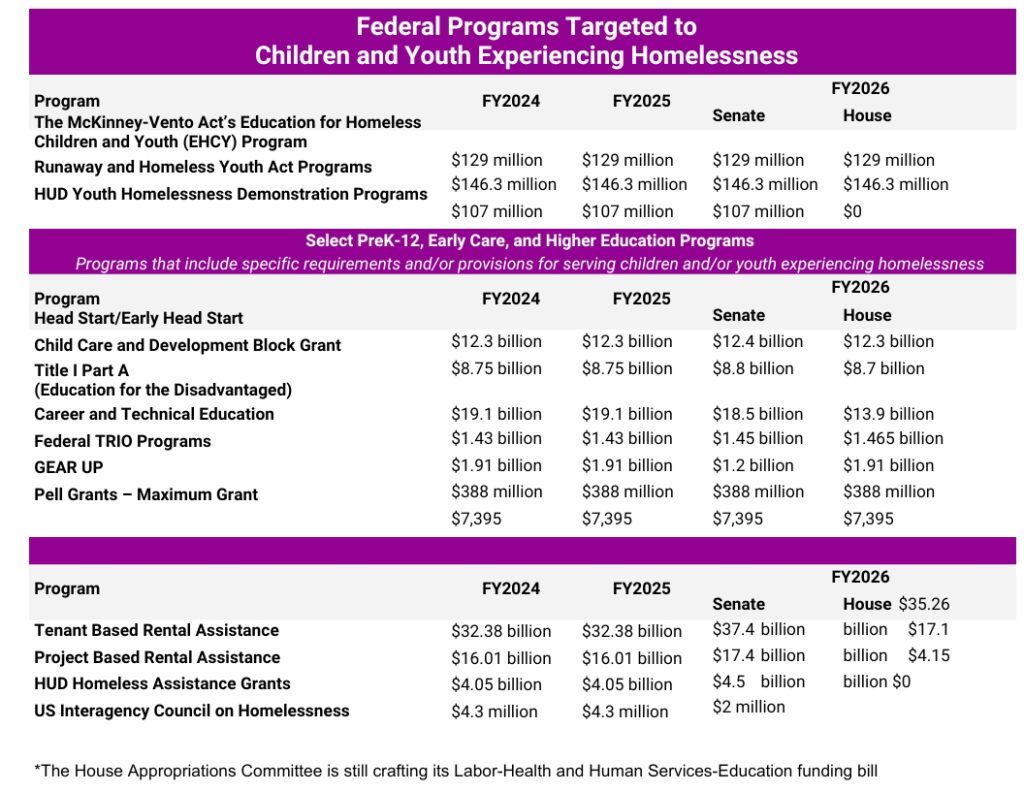
On Monday, September 1st, the House Labor-HHS-Education Appropriations Subcommittee passed its FY2026 funding bill on an 11-7 party-line vote. Notably, the House bill rejects the Trump Administration’s proposal to block grant the McKinney-Vento Act’s Education for Homeless Children and Youth (EHCY) program, and maintains EHCY funding at its current level.
What’s in the House proposal?
The House Appropriations Committee’s FY2026 funding proposal reduces, and in some cases eliminates, important early care and education programs. The bill cuts funding for Title I, Part A by 27% and eliminates a number of other important early care and education programs (including Title III English Learner Acquisition, Migrant Education, and Child Care Access Means Parents in School).
Overall, the bill funds the U.S. Department of Education at $67 billion ($12 billion or 15% below FY25 enacted) and the U.S. Department of Health and Human Services at $108 billion ($7 billion or 6% below FY25 enacted).
Programs with Funding Increases:
- Charter Schools – $500 million ($60 million ⬆️)
- Special Education – $15.493 billion ($26 million ⬆️)
- Impact Aid – $1.630 billion ($5 million ⬆️)
- Rural education – $225 million ($5 million ⬆️)
- Title IV-A – $1.385 billion ($5 million ⬆️)
- Career and Technical Education – $1.465 billion ($25 million ⬆️)
- Low-Income Home Energy Assistance Program – $4.035 billion ($10 million ⬆️)
Programs Receiving Level (Flat) Funding:
- McKinney-Vento Education for Homeless Children and Youth program – $129 million
- 21st Century Community Learning Centers (afterschool programs) – $1.3 billion
- Child Care and Development Block Grant – $8.7 billion
- Head Start – $12.3 billion
- TRIO – $1.43 billion
- GEAR UP – $388 million
- Pell Grants – $7,395
- Runaway and Homeless Youth Act programs – $146.3 million
Programs with Deep Cuts:
- Title I – $13.912 billion, a 5.2 billion cut (27%)
- Federal Work Study – $779 million, a $451 million cut (37%)
- Job Corps – $880 million, a $880 million cut (50%)
Programs Eliminated:
- Title I, Part C: Migrant Education – $376 million
- Title I, Part D: Neglected/Delinquent – $49 million
- Title III: English Language Acquisition – $890 million
- Preschool Development Grants – $315 million
- Supplemental Educational Opportunity Grants – $910 million
- Child Care Access Means Parents in School – $75 million
What Happens Next?
The full House Appropriations committee is expected to markup the bill in the coming days.
As explained in SHC’s federal policy webinars, the House bill is only one part of a lengthy appropriations process and is not the final FY2026 funding bill. The House will use this bill to enter negotiations with the Senate bill, which preserves most early care and education funding (read more about the Senate bill).
Given the September 30th deadline for government funding, the most likely immediate scenario is a series of short-term spending bills (“Continuing Resolutions, or CRs”) that keep the government open while broader negotiations occur.

The Big Picture: Advocacy Works! And Continued Advocacy Needed
Both the House and Senate preserved funding for EHCY in their FY2026 funding bills, which is a testament to your continued support and advocacy efforts. SHC connected more than 80 homeless education liaisons with members of the Appropriations Committee this year to share the direct connection of federal funding for homeless students to their congressional districts. Members of Congress and their staff heard about efforts to support the academic stability and advancement of students experiencing homelessness through federal dollars that have produced lower chronic absenteeism rates, higher graduation rates, and increased academic achievement. Liaisons powerfully demonstrated that federal investment enables local school districts to meet the unique needs of their students who are experiencing homelessness so they can be successful in school and in life.
The FY2026 funding bill is not finalized at this time, and will require sustained advocacy until Congress finalizes the budget for the full year. The House and Senate bills differ dramatically and we must ensure that programs supporting children, youth, and families experiencing homelessness continue to receive dedicated federal investments.
If you would like assistance in meeting with your members of Congress, please email TJ Lucas, Senior Manager for Federal Policy.