
Senate Committee Advances EHCY Funding, Rejects Block Grant
The Senate Committee rejects EHCY elimination, preserving $129M in funding. Learn what’s next and what else is included in the FY2026 education bill.
On Thursday, July 31st, the U.S. Senate Appropriations Committee voted 26-3 to advance the FY2026 Labor, Health and Human Services, and Education (Labor-HHS-Ed) funding bill – which includes continued dedicated funding for the McKinney-Vento Act’s Education for Homeless Children and Youth (EHCY) program.
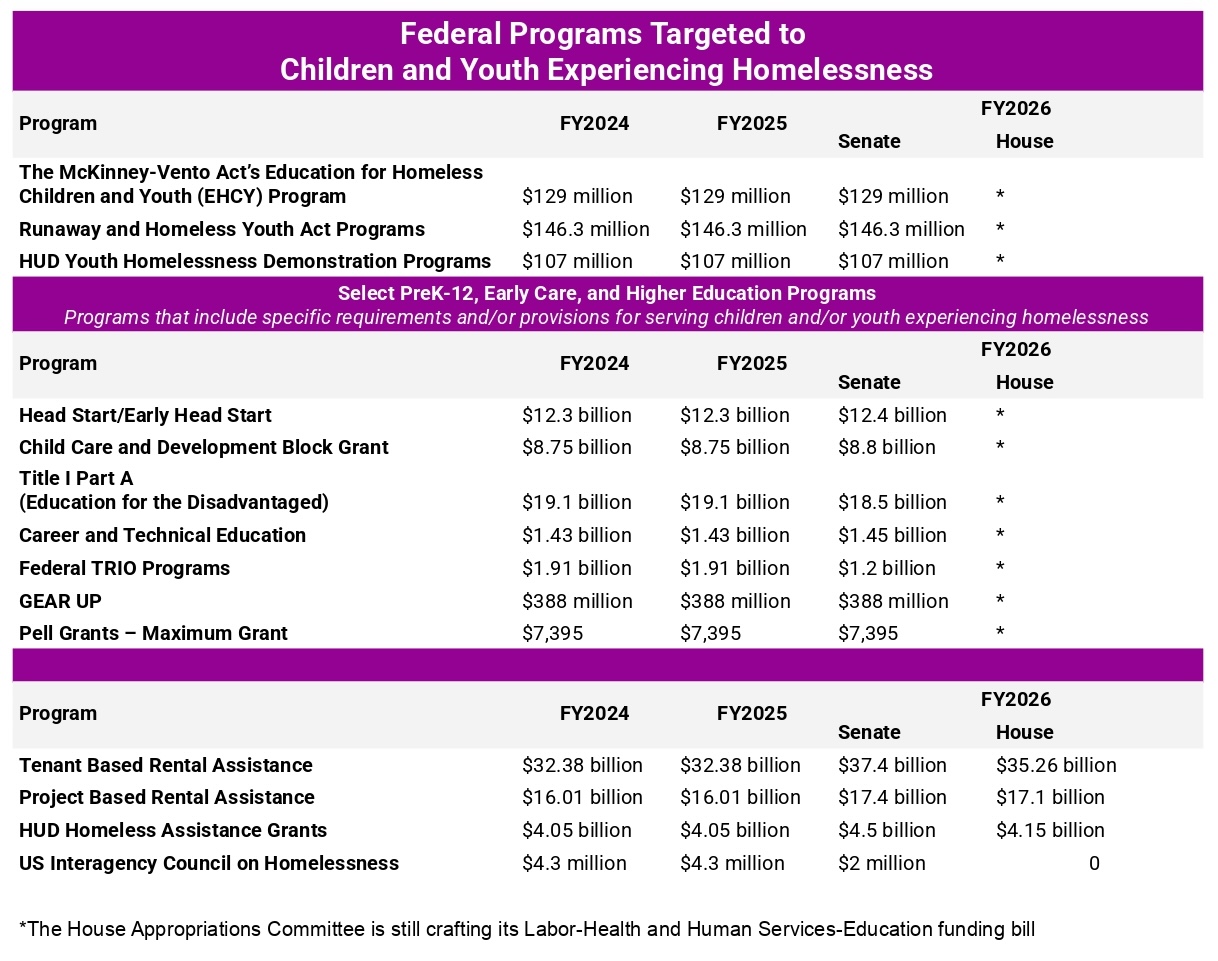
In a strong show of support, the Senate Committee rejected a proposal in President Trump’s FY2026 budget request to eliminate the EHCY program entirely by consolidating it into a new education block grant. Specifically, the Senate bill includes $129 million for the EHCY program, which supports school district homeless liaisons, ensures school access and stability, and directly helps reduce chronic absenteeism and increase graduation rates for students in crisis. The Senate bill also provides funding for all other federal early care and education programs targeted for elimination in the President’s proposal.
What Happens Next?
The Senate Committee vote is only one step in deciding funding levels for FY2026 (the 2026-2027 school year). The bill still needs support from 60 members in the full Senate, and the House version might be significantly different. The House Appropriations Committee is set to markup its version of this bill the first week in September – so your advocacy is still needed.
Given the short legislative calendar, Congress is likely to consider a Continuing Resolution (CR) to avoid a government shutdown when the fiscal year ends on September 30th. Under a CR, federal programs like EHCY are typically funded at current levels until a full-year bill is enacted.
Nonetheless, the Senate vote sends a clear, bipartisan message: many Senators understand that dedicated federal investments in children and youth experiencing homelessness matter. The vote reflects bipartisan recognition of what school district homeless liaisons have long known: dedicated EHCY funding stabilizes children and youth during crisis, keeps them in school, and gives them a real chance at graduation and long-term success.
What Else Is In This Bill?
- $129 million for the McKinney-Vento Act’s Education for Homeless Children and Youth (EHCY) program (the same as the current level)
- Bill language allows EHCY funds to be used for one additional fiscal year
- Bill language requires the U.S. Department of Education (ED) to disperse formula funding for education programs – including the EHCY program – on the required date, which in this case would be July 1, 2026. This language is meant to prevent the Trump Administration’s attempts to withhold funds that Congress approves.
- Report language directs ED to issue guidance that allow EHCY funding to provide short-term, temporary emergency housing (such as a hotel or motel room) on a case-by-case basis if reasonable and necessary to facilitate school attendance, and as a last resort when other funding sources are not readily available.
- Unaccompanied Homeless Youth FAFSA Determinations:
- Report language directs ED to correct any incorrect determinations that labeled “unaccompanied homeless youth” as “provisionally independent,” make publicly available the data of unaccompanied homeless youth and foster youth, and provide Congress with an update on this work specifically.
- Requires ED to maintain sufficient staffing to fulfill its statutory responsibilities, including carrying out programs, projects, and funded activities in a timely manner.
- $146.3 million for Runaway and Homeless Youth Act programs (same as the current level)
- Report language directing the Administration for Children and Families (ACF) to issue timely and separate notices of funding availability for the the Street Outreach Program, Basic Center Program, Transitional Living Program, and Maternity Group Homes.
- Report language supporting RHYA prevention services.
- $5 million for Youth Homelessness Prevention Demonstration projects administered by ACF
- $15.2 billion for IDEA state grants (up $50 million from the current level or 0.3%)
- $18.5 billion for Title I Grants to LEAs (up $50 million from the current level or 0.3%)
- Prohibits any enacted funding from being used to transfer Title I state grants or special education state grants out of ED
- $8.8 billion for Child Care Development Block Grant (up $85 million from the current level or 1.0%)
- $12.4 billion for Head Start (up $85 million from the current level or 0.7%)
- Pell Maximum Award: Maintains the maximum Pell award for a total of $7,395 for the 2026-2027 school year.
- $10 million for institutions of higher education to meet the basic needs of Pell-eligible and other low-income students.

Educating Policymakers is Essential!
At SchoolHouse Connection, we’re proud to help connect educators, service providers, and advocates directly with Congressional offices to share exactly how these dollars work on the ground.
In meeting after meeting, policymakers are hearing that EHCY funding:
- Reduces chronic absenteeism.
- Increases academic performance and graduation.
- Helps schools respond quickly, flexibly, and appropriately to the complex realities students face when they lose their homes.
SHC will continue advocating to preserve dedicated federal funding along with the strongest possible funding levels and protections for students experiencing homelessness – and ensuring the voices of those on the front lines are at the table.
If you’re interested in helping to educate your Members of Congress, please email TJ Lucas, Senior Manager for Federal Policy.