2026 Fact Sheet: K12 Students Experiencing Homelessness
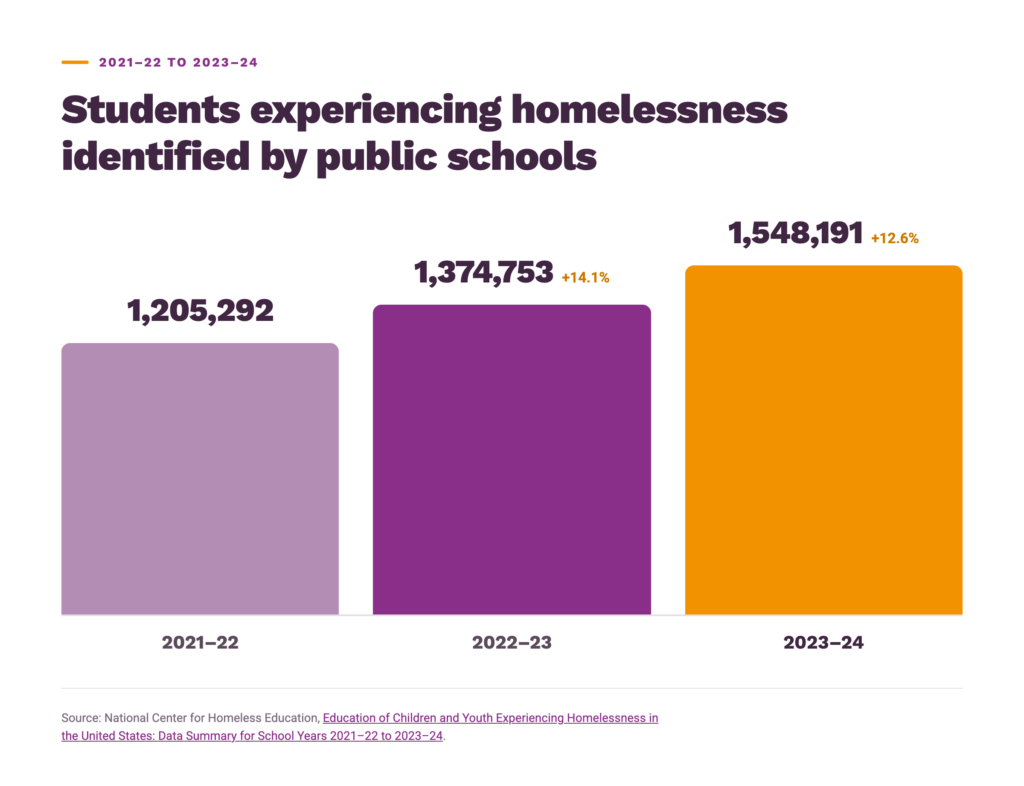
This resource brings together the most current student homelessness statistics and a plain-language explanation of the Education for Homeless Children and Youth (EHCY) program. In the 2023–2024 school year, public schools identified more than 1.5 million students experiencing homelessness — the highest number since national reporting began in 2004. This fact sheet explains what the data show and why the EHCY program matters.
For information on student homelessness by state, county, local educational agency, U.S. Congressional district, or state legislative district, check out our Data Profiles tool.
The Education for Homeless Children and Youth (EHCY) program, established under the McKinney-Vento Homeless Assistance Act in 1987, provides basic access to education for over 1.5 million children and youth experiencing homelessness.
The EHCY Program is the only federal program dedicated to identifying homeless students and removing barriers to their school attendance and success. Without the protections provided by the McKinney-Vento Act, homeless students will struggle to attend any school, or benefit from any federal, state, or local education funding.
What Unique Barriers Do Students Experiencing Homelessness Face?
Students experiencing homelessness face unique barriers beyond poverty, such as frequent school transfers, lack of transportation, lack of a fixed address for enrollment, and the stigma and fear of homelessness.
Homelessness disrupts the lives of children and youth in rural, suburban, and urban communities, but is more hidden in rural and suburban communities. Schools are often the only source of support for homeless students in rural and suburban areas.
Approximately 8.3% of homeless students are not in the physical custody of a parent or guardian. These students are often homeless as a result of abuse and neglect, but are not in the custody of child welfare agencies. They face additional educational barriers and are at high risk of trafficking and predation.
How Does Homelessness Affect Attendance and Graduation?[1]
On average, states report that nearly half (47.7%) of their identified homeless students were chronically absent in the 2023-2024 school year. This is a 3.1% decrease over the previous two school years, but still 11 percentage points higher than before the pandemic (2018-2019 school year).
National 2023-2024 data on chronic absence rates are not yet available for economically disadvantaged students. However, in every one of the 31 states that have publicly reported chronic absenteeism data for both students experiencing homelessness and for economically disadvantaged students, students experiencing homelessness had a substantially higher chronic absenteeism rate in the 2023-2024 school year – on average, the homeless student chronic absence rate was 16.43% higher than for economically disadvantaged students.[2] Because some states may count students experiencing homelessness within the economically disadvantaged subgroup, this comparison likely understates both the size of the gap and the distinct effect of homelessness on chronic absenteeism.
The 2022-2023 national average graduation rate for homeless students was 69.1%. This is 12.8% percentage points below other low-income students, and nearly 17.6% percentage points below all students.
Youth without a high school diploma or GED are 4.5 times more likely to experience homelessness than their peers who completed high school, making lack of a high school diploma or GED the single greatest risk factor for experiencing homelessness as a young adult – and making education a critical prevention strategy.[3]
When Barriers Are Removed, Homeless Students Can and Do Succeed in School, Which is Their Best Protection Against Future Homelessness
Some school districts and states are closing the gap between students experiencing homelessness and other students, demonstrating that with focused attention and resources, barriers can be overcome.
What Does the EHCY Program Provide?
It provides:
1. School Stability
Homeless students can continue attending the same school if it is in their best interest, even if their homelessness forces them to move. Transportation is provided to help maintain school stability.
2. School Access
If staying in the same school is not in their best interest, homeless students are immediately enrolled in a local school while school records are obtained, limiting educational disruption.
3. School Support
Every school district designates a local liaison to identify homeless students and provide support, including referrals to community agencies and training for school personnel. Funding is used for direct services to students and families.
The EHCY Program Plays a Critical Role During Disasters and Economic Downturns
Events like hurricanes, wildfires, and floods can create lasting homelessness for families and youth. For example, public schools in South Carolina, North Carolina, Florida, and Georgia have identified over 5,100 newly homeless students as a result of Hurricanes Helene and Milton. The EHCY program has a proven track record of providing educational access and support to these students.
During economic downturns and housing crises, homelessness often spikes. The EHCY program provides a safety net to ensure children and youth remain in school during these times of upheaval.
Recent Funding History
FY2026
Congress appropriated $129 million for the EHCY program, allowing about one in five (20.79%) school districts to receive dedicated funding.
Unanimous, Bipartisan Amendment to American Rescue Plan (ARP) Act, 2021: An additional $800 million was dedicated to aid the identification and support of homeless students, which enabled over half of U.S. school districts to access EHCY support. An evaluation of early impact found improvements in identification, attendance, and achievement.[4]
As sobering as these numbers are, there is strong evidence that homelessness in public schools remains under-identified, and that the true scale of child and youth homelessness is even larger – particularly considering that infants, toddlers, and other young children are not fully represented in the data.
The Education for Homeless Children and Youth (EHCY) program, established under the McKinney-Vento Homeless Assistance Act in 1987, is the only federal program dedicated to identifying homeless students and removing barriers to their school enrollment, attendance, and success.
Under the McKinney-Vento Act, children and youth are considered homeless if they lack “fixed, regular, and adequate nighttime residence” (42 U.S.C. §11434a(2)) — which includes staying temporarily with other people, or in motels, shelters, or unsheltered situations.
Three core things: school stability (the right to stay in the same school even after a move, if in their best interest, with transportation provided), school access (immediate enrollment while records are gathered), and school support (a designated local liaison in every district).
States report that nearly half (47.7%) of identified homeless students were chronically absent in 2023–2024 — a rate substantially higher than for other low-income students in every one of the 31 states with comparable public data.
The 2022–2023 national graduation rate for homeless students was 69.1% — 12.8 percentage points below other low-income students and 17.6 percentage points below all students.
No. Homelessness disrupts education in rural, suburban, and urban communities alike — it’s simply more hidden in rural and suburban areas, where schools are often the only source of support.
Approximately 8.3% of homeless students are not in the physical custody of a parent or guardian. These students face additional educational barriers and elevated risk, and are often not in the child welfare system despite lacking parental custody.
[2] From Attendance Works and SchoolHouse Connection’s forthcoming analysis of publicly available state-level data on chronic absenteeism. States include: AZ, CA, CO, CT, DE, DC, GA, HI, ID, IL, IA, KS, KY, LA, ME, MD, MI, MO, MT, NJ, NM, ND, OH, OR, RI, SC, SD, UT, VA, WA, WV