
Engaging Families Experiencing Homelessness: Practical Strategies for Liaisons and School Staff
In collaboration with Home Works, this resource provides practical, field-tested strategies to help liaisons and school staff engage families experiencing homelessness.
Families experiencing homelessness face unique challenges that can impact their children’s attendance, learning, and well-being. Building trust and strong relationships is central to effective engagement. The strategies below combine SchoolHouse Connection’s expertise in homelessness with Home Works’ proven family engagement model.
| Defining the Terms | |
| Home Works operates with the working definition of family engagement as a set of behaviors that families and caregivers intentionally and continuously practice that positively impact a child’s learning at home and academic success at school. | According to the McKinney-Vento Homeless Assistance Act, homelessness is defined as children and youth who lack a fixed, regular, and adequate nighttime residence. This includes staying in shelters, in motels/hotels, temporarily with other people(“doubled-up”), or in unsheltered locations. |
1. Build Trust and Maintain Consistent Communication
- Refer families to community resources or provide school devices to ensure regular communication by phone, text, or email – even when families don’t request help.
- Follow up on needs and share updates, even if solutions are still in progress.
- Communicate respectfully, without judgment, and in families’ preferred language.
2. Meet Families Where They Are
- Conduct home visits or meet in shelters, motels, libraries, community centers, or parks.
- Maintain a presence in shelter or motel offices to increase accessibility.
- Provide confidential, welcoming spaces for conversations.
3. Provide Clear Information on Rights and Resources
- Share accessible explanations of McKinney-Vento rights through flyers, QR codes, and multilingual audio recordings.
- Revisit this information multiple times during the year.
- Offer practical guidance about attendance expectations and protections under McKinney-Vento.
4. Collaborate with Community Partners
- Host joint office hours, family nights, or resource fairs with local service providers.
- Establish referral processes using simple text, email, or online forms.
- Partner with community organizations to create resource centers offering health and social services on school grounds.
5. Empower Families as Decision-Makers
- Use tools such as the Home Works Plan for Student Success worksheet to guide conversations.
- Offer workshops on learning at home and organize peer support groups.
- Involve families in shaping programs, events, and school decisions.
6. Remove Barriers to Participation
- Offer transportation (cabs, rideshares, bus passes, gas cards) and childcare through partnerships with student groups or community volunteers.
- Provide flexible meeting options—virtual, phone, in-person—at varied times.
- Ensure translation and interpretation services are consistently available.
7. Support Attendance Through Engagement
- Replace generic attendance letters with personalized, supportive communication.
- Track attendance with sensitivity; use identifiers in student information systems to help ensure that absences related to homelessness are not counted against students.
- Train staff to raise awareness of housing situations during school events and check-ins.
8. Leverage Funding and Resources
- Use Title I family engagement funds for home visits, translation, transportation, supplies, and workshops.
- U.S. Department of Education Family Engagement Non-Regulatory Guidance (See questions C-12 through C-15)
- Use Title I, Part A homeless set-aside funds for outreach, supplies, transportation, and family engagement activities.
- SchoolHouse Connection’s Maximizing the Title I Set-Aside for Homeless Students: An Actionable Guide for Practitioners, Leaders, and Advocates
- U.S. Department of Education Education for Homeless Children and Youth Non-Regulatory Guidance (See Section M for information on Title I, Part A Homeless Set-Aside Funds)
- Collaborate across programs to braid or blend funds and engage community partners in providing resources.
Learn from Successful Models
Home Works partners with schools to strengthen family-school partnerships through home visits, family dinners, and workshops.
Home Works collaborates with schools in urban and rural areas to bring teachers and families together as true partners in ensuring every student gets the individualized support they need to thrive. Through Teacher Home Visits, Family Dinners and Family Learning Workshops, Home Works creates strong, collaborative relationships between home and school.
This 3-pronged approach is delivered in the same manner across all urban and rural environments, with the flexibility for schools to adjust based on their families’ needs.
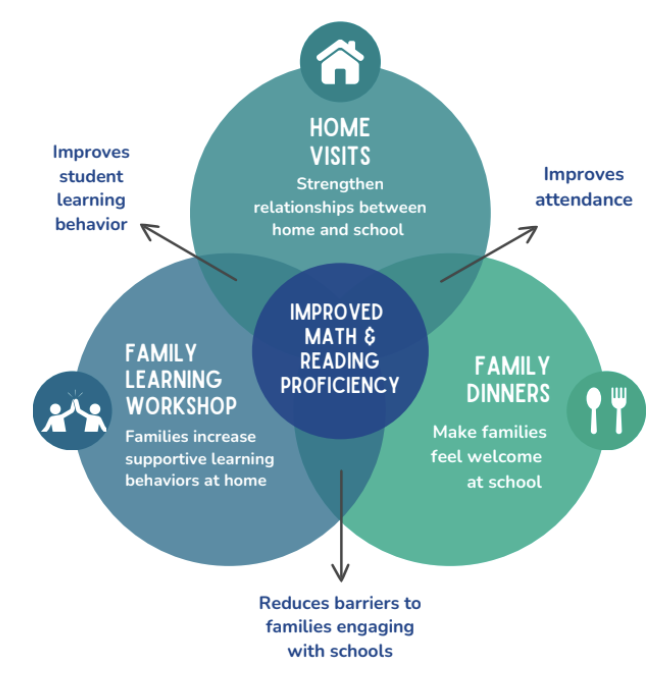
How does Home Works help to build capacity for family engagement at partner schools?
| Confluence Academies (urban) | Jennings School District (urban) | Boonville School District (rural) |
| Confluence Academy hosts 2 different Family Dinner rotations during back-to-school events for Pre-K-8th grade to accommodate its large student and family population. This allows all families ample time to visit the exhibit tables of community partners and local nonprofits offering educational resources. | Jennings School District combines Family Dinners and Family Learning Workshops with block parties and student performances to boost engagement and attendance. Middle and high school students volunteer to support younger youth, assist with event setup, and help with childcare so parents can connect with teachers. | Boonville School District hosts visits at the school site (outside of the classroom) to support engagement, as community meeting spots are not easily accessible to families. |
In general, Home Works recommends providing translation services for families who are not fluent in English and addressing transportation barriers that may prevent participation in school-sponsored programs.
SchoolHouse Connection Resources
- Flyers, Posters, and Infographics
- Potential Indicators of Homelessness
- Homeless Education Directory
- Sample Housing Questionnaire
- Sample Needs Assessment
- 6 Things to Know About Privacy, FERPA and Homelessness