A Project Supported by the Imagine Learning Foundation
Inspiring Best Practices for Improving Attendance of Students Experiencing Homelessness
Amid a rise in the number of students experiencing homelessness and high rates of chronic absenteeism, SchoolHouse Connection and Attendance Works partnered to identify the best practices for bringing these vulnerable students back to school regularly.
Explore Chronic Absenteeism Data
Access national, state, local, school district, and Congressional district data.
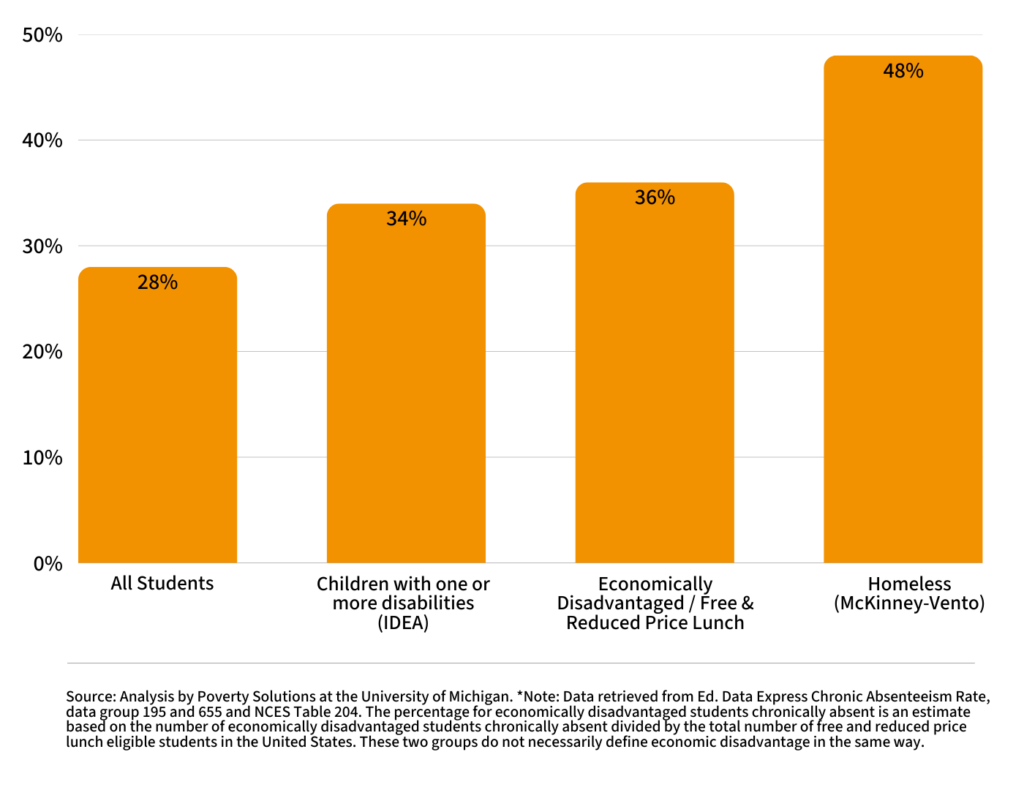
Homelessness creates major barriers to school attendance, with chronic absenteeism rates for homeless students 12 percentage points higher than other low-income students and 22 percentage points higher than the general population. Factors like mobility, trauma, and lack of basic resources contribute to these challenges. This often-overlooked student group should be prioritized in district-wide efforts to reduce absenteeism.
This page includes best practices from school districts nationwide that have improved attendance for students experiencing homelessness, key takeaways, and information about a two-part webinar series that will share these best practices and offer implementation guidance for a national audience.
A data-driven district that reduced chronic absenteeism among homeless students by 6.5 percentage points while increasing graduation rates to 93%. Henrico’s five-member team specializes in identification, transportation, attendance, and community partnerships, with a focus on early intervention. Their approach combines regular data tracking with strong community connections, including partnerships with local businesses and nonprofits that provide food, clothing, and comprehensive support services.
This suburban Denver district has built a culturally diverse 16-member team to support homeless students, resulting in a dramatic one-third reduction in chronic absenteeism over three years. Adams 12 has implemented automated attendance alerts, developed a comprehensive case management system, and established a refined process for leveraging Medicaid funding to support vulnerable students. Their human-centered approach focuses on creating environments where students want to attend school.
A small rural California district making significant impacts on student attendance through data-driven strategies. Coalinga-Huron reduced chronic absenteeism rates for students experiencing homelessness by 10.6 percentage points in a single year through weekly team huddles, county-level coordination, and community partnerships. Their approach demonstrates how a small district with strong support can use data and teamwork to create meaningful change for vulnerable students.
This urban district successfully reduced chronic absenteeism among homeless students from 74.3% to 62.7% by integrating attendance and homelessness initiatives. The district embeds homelessness specialists in schools, uses specialized transportation services, and coordinates with community organizations to provide wraparound services. Their partnership approach demonstrates how coordinated efforts between attendance teams and McKinney-Vento services can improve outcomes for vulnerable students.
From Student Navigators to Mental Health Assessments: More Best Practices to Increase School Attendance for Students Experiencing Homelessness
As the number of students experiencing homelessness rises across the nation, so does the need for strategies that help these students attend school regularly. To this end, SchoolHouse Connection and Attendance Works spoke to school districts across the country to find the best approaches for improving school attendance for this population. In addition to our featured case studies, we identified innovative strategies in six more school districts.
In late 2024 and early 2025, SchoolHouse Connection and Attendance Works spoke to school districts across the country to distill some successful approaches and effective tools for improving attendance among students experiencing homelessness. Ten key strategies are summarized below.
Train school staff to help identify students who are eligible for support.
Track attendance data and use the findings to drive change.
Break down silos across school district departments.
Demonstrate respect for family and youth circumstances.
Focus on transportation to remove one of the biggest barriers.
Provide mental health support.
Engage community-based organizations.
Tap local education foundations to provide flexible funds.
Maximize Title I Part A homeless set-aside funds to increase staff capacity and services.
Encourage states to supplement local and federal funding.
This document is an action planning template designed to help school districts improve attendance for students experiencing homelessness. It guides users through a structured reflection process across five key areas—identification, data use, funding, transportation, and community partnerships—by prompting them to assess current efforts, identify gaps, and plan next steps.
Below are quotes from young people describing the challenges they faced attending school while experiencing homelessness, the support they needed, and how schools could have better accommodated their circumstances.
What barriers did you face in consistently attending school while experiencing homelessness?
During a portion of my homelessness, I would take the public bus to school with my dad. Sometimes my dad would experience periods of depression I assume and he would lay in bed all day everyday for as long as a week straight. This made it difficult to get to school because he was the only one I had to help me safely arrive at school for a period of time. He wouldn’t take me to school and would get angry at me for expressing my desire to go to school. Another barrier I had when I was taking the school bus, my school bus driver put me in uncomfortable situations. When she would come to get me, she would park far down the road and would force me to walk to the bus even if it wasn’t at the correct location. It was especially hard because she would park next to an area where a bunch of men would sit and sometimes they wouldn’t be wearing clothes or would try talking to me. If I didn’t walk over there, she would just drive away. It just made me dread getting to school. When I would take the school bus home, I would have to ride the bus with the high schoolers, the middle schoolers, and the grade schoolers, and then I would finally be dropped off. This made me also not look forward to going to school.
— Samantha
It was hard to balance keeping up with grades, assignments and school because I had to work and make sure I was going to be able to have enough money to eat and honestly survive. I started to become more and more absent because work became a priority then getting to school on time.
— Mariah
The barriers that I faced were mainly due to the issue of not having any control over whether I could attend school or not. People had to drive me to school, due to me moving around constantly and not always being in district, though there were times where I was able to ride the bus. I was luckily able to attend most school days, only missing a few here and there, but it was definitely a stressful time in my life that I wouldn’t wish upon others.
— Zyden
I think the biggest barriers to attending school were always transportation, energy, and embarrassment. I lived around 45 minutes away from my school at the time and I would need to bike there: some days, I just could not get myself to do it. Both because of how physically nd mentally taxing homelessness is, but also because I would need to wake up at five am to get there. Also, by the time I was at school, I would usually be drenched in sweat. Once I got out of homelessness, the trauma got in the way–some days I would be too anxious/depressed to leave.
— Anonymous
I am a person who grew up poor at all times. I have moved so many times and switched to over 10 different schools. There were tons of barriers I had to overcome, but the two that I am still dealing with to this day is making friends and finances. It took until high school until I was able to be at a school longer than a year or two. I have grown to become better at communication, but I cannot get the grasp on building a great connection with another even in college. I wish I had the time to build some sort of lasting relationships with the people I grew up with. As for finances, I am learning. Up until last year, I had no clue what I was doing. This was even worse the two times I was homeless, as I had no idea what support systems I could rely on.
— Joshua
In my younger years, I lived in a campground several miles out of town. I remember the only way to get to school was by biking since the school bus and city bus didn’t go out that far. When we first moved to the campground, it was still August, so it wasn’t a big deal taking 1-2 hours to get to school on my bike. But as winter came, especially a Montana winter, it progressively got more and more difficult to get to school while I was in that living situation. Sometimes, I wouldn’t be able to go to school because of the temperature or other biking issues.
— Anonymous
Transportation was a huge issue—I didn’t always have a reliable way to get to school, and there were times when just getting there felt impossible. On top of that, not having stable housing meant struggling with basic things like clean clothes, school supplies, or even a quiet place to do homework. The emotional toll was also real—dealing with shame, stress, and feeling like I didn’t belong made it hard to stay motivated.
— Te’yana
Transportation. Thankfully, I was older when I experienced homelessness, so I had a driver’s license, but ensuring I was able to keep my car was challenging due to limited finances. I was given a gas card where I was reimbursed for my travels to and from school since I was unable to use their buses. (I wanted to stay at my initial high school opposed to transferring and this allowed me to do so.)
— Cheyenne
One of the biggest challenges I faced was constantly moving between houses and not having a stable home. This made it difficult to get to school on time because I didn’t have access to a car. I had to rely on the city bus, biking, or walking most of the time. With all the effort it took just to get there, it sometimes felt easier to give up, especially when the journey itself became overwhelming.
— Ashly
Having clean clothes, getting enough sleep
— Anonymous
For me personally during the roughest time periods of homelessness when me my sister and our parents where sleeping in a shared tent it was predominantly transportation. While the self esteem aspect of having dirty cloths and bug bites didn’t help it certainly impacted my sister more than myself. I was always asking how we were gonna get to school and there were days where my parents made no effort to get us there at all, thus whenever possible if i knew the area would take measures into my own hands. At one point for almost half a year lyfting to school and back home and to work for myself along with my sister.
— Damien
Transportation to get from school to wherever I was staying and vice versa. Also attendance. Being punished at school due to forces outside of your control sucks.
— Mary
I would say my three biggest barriers to consistently attending school while experiencing homelessness were transportation, priorities, and support. Without a car and constantly couch surfing, I couldn’t rely on a bus to pick me up and drop me off. When I learned that I could receive Marta cards, I still had to walk to and from where the busses would stop, and inclement weather almost always made it feel impossible to start the day on a positive note. In terms of priorities, I was always trying to balance work and school, but work was essential for my survival, while school felt less crucial. It would have been helpful if teachers had been more understanding of the challenges I was facing.
— Shakara
What could your school have done that would have made it easier for you to attend regularly? Were there unmet needs or missed chances for assistance that your school could have helped with?
It would have been helpful if they took my complaint against my bus driver seriously. It also would have been nice if the school could have found a way for me to get dropped off without making me ride with the middle schoolers and grade schoolers. It made me miss a lot of time I could have spent studying.
— Samantha
I think just asking overall, like what they could do to best support me and maybe giving me a work study or resources.
— Mariah
My school understood my situation and tried their best to meet my needs. They offered clothing and other household supplies throughout my time in High School. They didnt realize that I was experiencing homelessness until I found a foothold, myself, though. I believe that all schools could benefit by preparing their teachers to help children that are in need, both mentally and emotionally. People don’t often know the signs someone is struggling until it’s too late, namely because teens who are don’t always show the struggle they are going through, so knowing that someone is homeless, or at risk of it, is important to forming a healthy educational environment.
— Zyden
I think if the McKinney-Vento liason had caught my homelessness sooner, I would have not had to bike because a UTA pass, which is our local transportation pass, could have been provided for me.
— Anonymous
There were a few schools I attended that had some sort of programs with people who assist kids that had a family that struggled financially, but there was only so much they can do. There was a school in Colorado I attended that required uniforms that we could not afford, but the school could only offer us a few shirts. There have been times when we were living in a homeless shelter where we missed school because there wasn’t a bus near us that would pick us up.
There have also been times where I had to skip on lunch because we had no money to pay, and they had no financial system to help with this issue.
— Joshua
I think if the school had been able to extend its boundaries to reach further outside of town, I would have been able to attend school regularly. It would have made a huge difference, especially during the bad Montana winters when biking was nearly impossible. Having reliable transportation would have helped make sure I didn’t miss out on important school days and not fall behind.
— Anonymous
My school could have done more to provide support without making it feel like a burden to ask for help. Things like free transportation options, access to laundry facilities, or a designated staff member who actively checked in on students facing housing instability would have made a difference. Even small things—like understanding teachers who didn’t immediately penalize missed work—could have helped ease the stress of falling behind.
— Te’yana
Connecting me with other resources, not just those for traditional school students, such as SNAP or Medicaid, would have greatly benefitted me. Also, a peer-mentor program or any 1:1 time with a professional would have been great, too. Most importantly, granting me McKinney-Vento status sooner, when my homelessness actually started, rather than 6 months before graduating, would have helped so much.
— Cheyenne
One thing the school or district could have done is to extend bus routes. I needed a bus, but because I wasn’t zoned to my school, transportation wasn’t available for me. Another issue was how lateness was handled. If I arrived late after a long journey, the office would sometimes send me back home. This was discouraging because I had already worked so hard to get there. Knowing I might be sent home just for being late made it harder to even try if I realized I was running behind.
— Ashly
Have washers and dryers or allowed me to sleep in the nurses room for an hour or two
— Anonymous
There were some that made it a hassle to converse with my parents and would have me take what felt like senseless steps to acquire a bus pass although I can’t entirely recall the full process as I was young and definitely stressed out of my mind.
— Damien
Provide transportation or bus passes and loosen punishments on those with extenuating circumstances. Be more open about. McKinney vento
— Mary
They could have been more consistent in providing Marta cards, support, and financial assistance for things like school dues. Spending so much on transportation often prevented me from covering other necessities, and if schools had understood that, it would have made a big difference. My only advocate in school was my counselor; she always stepped in when teachers were giving me a hard time. It seemed like all of my teachers were aware of my situation, yet they still needed to be addressed instead of simply being understanding and accommodating.
— Shakara
If attending school was entirely outside your control, what could schools have done to reduce the negative impact of your absences on your learning and experience?
A lot of my teachers treated me in a negative away because of how often I missed classes. They seemed to act like it was my fault. This made me feel anxious about facing my teachers in class. Schools could have stressed the importance of treating students fairly despite how many absences they had.
— Samantha
Like I said before, just asking the questions. Instead of assuming I was just not trying providing resources or having meetings about what the school could do to help.
— Mariah
While i did not lose as many learning opportunities as i could have, I believe that having teacher material online can help students learn if they are not able to attend. Recording lectures, powerpoints, and teacher notes could have improved my learning for the days that I missed, without taking from my learning entirely. This increased during covid but has fallen since. This could be a huge resource for those who need some control in their life, meaning they wouldn’t lose their education.
— Zyden
I think being absent is always going to me negative–however, in terms of mitigation, it would be useful for students to know exactly what they are missing that day. If high school had something more akin to syllabuses like colleges do, it would be easier for me to keep caught up.
— Anonymous
I believe every school should have some sort of advisement for every student, regardless of what they know or not. The one person outside of those at School House Connection that helped my get through high school and even into college was my student advisor.
— Joshua
I think the school could have sent home materials. For example, if we knew it was going to be below zero and icy or there was a snowstorm, they could’ve sent that week’s work home with me. If I had my work at home, I could work through it on my own and at least not fall behind in classes. That way, I could stay on track even when the weather made it impossible to get to school.
— Anonymous
Schools could have been more proactive in reaching out instead of just marking absences. Having recorded lessons, online options, or structured catch-up programs would have helped me stay on track. A designated support system—like a teacher or counselor checking in—would have also made it easier to re-engage after missing school without feeling lost or discouraged.
— Te’yana
Offering remote learning for those not able to physically come in could be explored, especially if the child is at an age where they are able to do so. In my opinion, as long as the students are learning what they need to, why do they necessarily need to be expelled for not attending school face-to-face, especially if there are special circumstances making it harder for them to do so? This could be a last resort to salvage a student’s education, ensuring they still obtain their high school diploma despite their living situation. Bottom-line, the question should always be “How do we keep this student enrolled so that they can receive their education?
— Cheyenne
Attending school consistently was really difficult, and I understand that schools and districts rely on attendance for funding. However, one thing I’ve never liked is how schools penalize students by taking away credit if they have too many absences, even when those students are performing well academically. If a student is getting good grades and staying engaged in class, schools should focus on supporting them rather than punishing them for circumstances outside their control.
— Ashly
Been more understanding
— Anonymous
Just really reach out more knowing my parents definitely dodged some calls if they informed close family or myself to a certain extent perhaps me and my sister would have been better supported.
— Damien
Ease. On. Punishments for absences and tardies. Remove one size fits all punishments or treatment.
— Mary
Instead of punishing or penalizing me for being absent, schools should focus on how they can support me while also holding me accountable. Personally, I didn’t like being treated differently from other students, but I had to remind myself that my circumstances were unique. Schools could provide a safe space for students to do their work. I also believe there should be exceptions to the rules about holding students back a grade for attendance. If I’m experiencing homelessness and doing my best to attend school and succeed, being held back would be discouraging and disheartening. While I’ve never been held back because I’ve been fortunate enough to excel academically, my heart truly goes out to those students who struggle and receive little to no support from the school.
— Shakara
Series: Inspiring Best Practices for Improving Attendance of Students Experiencing Homelessness
SchoolHouse Connection and Attendance Works interviewed school district leaders across the country to find promising approaches for reducing chronic absenteeism among this population. We hosted this two-part webinar series on March 13 & 18, 2025.
Presenters in both sessions include:
Barbara Duffield – Executive Director, SchoolHouse Connection
Hedy Chang – Executive Director, Attendance Works
Jessica Smith, LMSW – McKinney-Vento Coordinator, Kansas City, Kansas Public Schools
Lisa Ann H. Abernathey – CCTP-TRE Education Specialist – McKinney-Vento, Henrico County Public Schools
Lisle Reed – Whole Child Initiatives Coordinator Student Engagement Initiatives, Adams 12 Five Star Schools
Lori L. Bailey – Student Engagement Initiatives, Adams 12 Five Star Schools
Jonathan Spreng – Director of Student Services and Family Supports, Coalinga Huron Unified School District
Part One: March 13, 2025
Part one of this two-part series focuses on boosting school attendance among students experiencing homelessness. This session brings together district representatives, program managers, and education leaders to share actionable strategies and real-world insights.
Key Topics Covered:
Data-driven approaches to identify and support at-risk students
Building strong relationships to foster trust and engagement
Leveraging community resources for holistic support
Innovative strategies to combat chronic absenteeism
Panelists highlight the power of authentic connections, targeted professional development, and celebrating progress—no matter how small. The session concludes with a call for greater collaboration, policy advocacy, and ongoing innovation to create lasting change.Watch the Replay
This must-watch second session of this webinar series dives deeper into proven strategies to enhance student identification, improve data-driven interventions, and foster community partnerships that support students experiencing homelessness. Replay the webinar to learn how to more effectively break down silos, secure funding, and implement attendance initiatives that make a difference.
Key takeaways include:
Innovative transportation solutions for homeless students
SchoolHouse Connection and Attendance Works would like to thank the following people for their leadership on this project: Hedy Chang, Barbara Duffield, Cecelia Leong, Anasofia Trelles, and Inika Williams. In addition, Phyllis Jordan provided writing support, Catherine Cooney handled communications, and Leconte Lee designed the case studies, materials and web page.
We are grateful for the generous support of the Imagine Learning Foundation for making this project possible.
About Imagine Learning Foundation
Imagine Learning Foundation is a nonprofit organization dedicated to fostering the well-being of learners and those who support them at home and in their communities. Established in 2021, the foundation provides funding to mission-aligned national non-profit organizations that focus on enhancing the well-being of youth, families, and educators, with an emphasis on accelerating student achievement. Imagine Learning Foundation is the philanthropic initiative of Imagine Learning, a leading creator of K–12 digital-first solutions, working alongside teachers to support 18 million students in over half of the districts nationwide.