
Support Bipartisan Letters for FY2026 Homeless Children and Youth Funding
Two bipartisan “Dear Colleague” letters are now circulating calling for continued federal investments in the McKinney-Vento Act’s Education for Homeless Children and Youth (EHCY) program and the Runaway and Homeless Youth Act (RHYA) program in the FY 2026 budget.
Spread the word: Use our social media toolkit to take action!
Congress has begun the annual process of crafting the Fiscal Year (FY) 2026 budget.
Two bipartisan “Dear Colleague” letters are now circulating calling for continued federal investments in the McKinney-Vento Act’s Education for Homeless Children and Youth (EHCY) program and the Runaway and Homeless Youth Act (RHYA) program in the FY 2026 budget.
- The House letter is authored by Congressman Danny K. Davis (D-IL), Congressman Don Bacon (R-NE), and Congressman Jimmy Panetta (D-CA). The deadline for this letter is May 15.
- The Senate letter is authored by Senator Alex Padilla (D-CA) and Senator Lisa Murkowski (R-AK). The deadline for this letter is May 21.
This year, more than ever, we need a strong showing of support.
The threat to homeless education is very real, as evidenced most recently in the President’s FY26 “skinny” budget that appears to eliminate EHCY’s protections and dedicated federal funds by consolidating EHCY with other education programs.
The more members of Congress who sign on to these bipartisan letters, the greater the show of support for protecting these programs in the FY 2026 budget.
- Please ask your member of Congress to sign on to the bipartisan letter in support of FY 2026 funding for children and youth experiencing homelessness TODAY. You can personalize the message, and offer to provide a copy of the letter and more information on the numbers and needs of children and youth experiencing homelessness in your community or state.
- Additionally, we are collecting endorsements from national, state and local organizations for EHCY and RHYA funding requests. If you would like to add your organizational endorsement, please complete this form.
Spread the word using our social media toolkit!
Copy and paste these posts to quickly share this urgent call-to-action with your networks.
Download image options here.
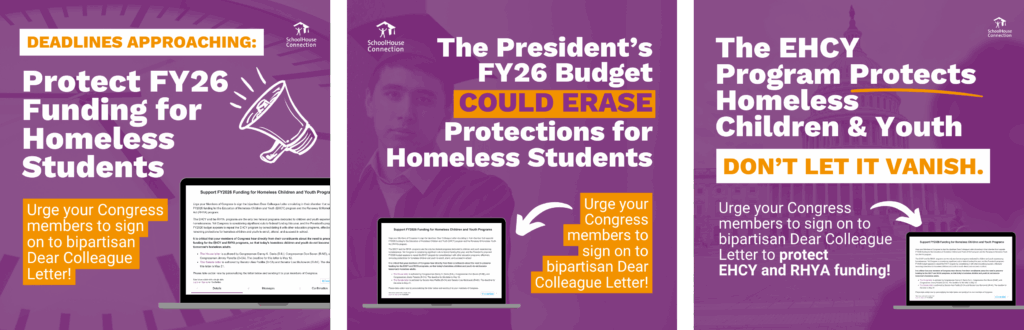
Post 1:
⏰ Two deadlines are fast approaching for your members of Congress to sign the bipartisan Dear Colleague Letter supporting FY2026 funding for the Education for Homeless Children and Youth (EHCY) and Runaway & Homeless Youth Act (RHYA) programs!
It is critical that Members of Congress hear from constituents to protect this funding.
📬 Take 2 minutes to send your message directly to their inboxes: https://bit.ly/4jMSWDC
Why? These are the only two federal programs dedicated to children and youth experiencing homelessness.
What’s at stake? The President’s proposed FY2026 budget appears to repeal the EHCY program by consolidating it with other education programs — potentially removing essential protections for homeless students to enroll, attend, and succeed in school.
🗓️ House deadline: May 12 | Senate: May 21
Post 2:
🚨The President’s FY2026 budget appears to repeal the Education for Homeless Children and Youth (EHCY) program by consolidating it with other education programs — a move that would strip away targeted protections for homeless students.
Why it’s urgent: EHCY is the only federal education program that removes barriers to school identification, enrollment, attendance, and success caused by homelessness.
Urge your Members of Congress to sign the bipartisan Dear Colleague Letter circulating now in both chambers to preserve FY2026 funding.
📬 Send your message now: https://bit.ly/4jMSWDC
⏰ House deadline: May 12 | Senate: May 21
Post 3:
The President’s FY26 budget appears to repeal the Education for Homeless Children and Youth (EHCY) program through consolidation, removing targeted protections for homeless students. Urge Congress to sign the Dear Colleague Letter & protect funding! https://bit.ly/4jMSWDC
Post 4:
Urge your Congress member: Sign the bipartisan Dear Colleague Letter to support FY2026 funding for EHCY & RHYA. https://bit.ly/4jMSWDC WHY: The President’s budget would eliminate protections for children and youth experiencing homelessness.
Post 5:
It is critical that Members of Congress hear from constituents like you to protect FY26 funding for homeless students. Urge them to sign the bipartisan Dear Colleague Letter circulating in both chambers! https://bit.ly/4jMSWDC⏰House deadline: May 12 | Senate: May 21
EHCY & RHYA Talking Points
- The McKinney-Vento Act’s EHCY program is the only federal education program that removes barriers to school identification, enrollment, attendance, and success caused by homelessness. No other federal program has the responsibility for and expertise in finding, engaging, and serving these students. Local liaisons help identify homeless children and youth, ensure school access and stability, provide direct services, and coordinate with community agencies to meet basic needs.
- At the current funding level, only one in five school districts receives direct support through EHCY. Without EHCY support, students experiencing homelessness struggle to enroll in and attend school and face barriers to accessing other local, state, and federal educational programs.
- A study of school districts that received targeted funding for homeless students in pandemic recovery showed measurable improvements in student attendance and academic performance.
- Lack of a high school degree is the single greatest risk factor for homelessness as a young adult, so an investment in EHCY is also homelessness prevention. For local information to share with your U.S. Senators, use our Child and Youth Homelessness Data Profiles to download data for your Congressional district.
- The Runaway and Homeless Youth Act (RHYA) funds community-based organizations to provide housing and services to youth and young adults. RHYA grants support short-term crisis housing for minors with a focus on family reunification, longer-term transitional living programs that help young people attain stability and self-sufficiency–including maternity group homes for pregnant and parenting youth–and street outreach programs connecting youth to services.
- RHYA programs help prevent and end the trafficking of youth. One in five young people experiencing homelessness have also been trafficked for sex, labor, or both. RHYA prevents trafficking by providing housing and support to youth and identifying survivors, ensuring their safety and support.
- RHYA programs are highly effective—over 90 percent of youth exit to a safe, stable living situation, 70 percent graduate or earn a GED, and 82 percent are employed or job-seeking at exit. Yet, due to underfunding, RHYA programs reach only a sliver of the youth in need. Only 25 percent of grant applicants receive funding, even with scores of 98/100 or higher, highlighting the urgent need for greater investment.
- The experience of homelessness as a young person is traumatic and significantly increases the risk of chronic homelessness in adulthood. Up to 25 percent of chronically homeless adults first experienced homelessness as minors, with another 25 percent first experiencing it between ages 18-25. Preventing chronic homelessness among adults requires addressing youth homelessness.
- RHYA programs offer more than housing. They connect youth to education and employment while building life skills and reconnecting families when safe. RHYA helps young people in crisis survive and transition to thriving adulthood.
Signers to the House letter
Adams, Alma; Ansari, Yassamin; Bacon, Don; Balint, Becca; Barragán, Nanette; Beatty, Joyce; Bell, Wesley; Bonamici, Suzanne; Boyle, Brendan; Brownley, Julia; Brown, Shontel; Carbajal, Salud; Casar, Greg; Casten, Sean; Castro, Joaquin; Cherfilus-McCormick, Sheila; Clarke, Yvette; Connolly, Gerald; Costa, Jim; Courtney, Joe; Craig, Angie; Crockett, Jasmine; Crow, Jason; Davids, Sharice; Davis, Danny; DeGette, Diana; DelBene, Suzan; Deluzio, Christopher; DeSaulnier, Mark; Dexter, Maxine; Dingell, Debbie; Doggett, Lloyd; Fields, Cleo; Foster, Bill; Frost, Maxwell; Garamendi, John; García, Jesús; Garcia, Sylvia; Golden, Jared; Goldman, Daniel; Gomez, Jimmy; Gottheimer, Josh; Hayes, Jahana; Himes, James; Horsford, Steven; Hoyle, Val; Jackson, Jonathan; Jacobs, Sara; Jayapal, Pramila; Johnson, Henry; Kamlager-Dove, Sydney; Keating, William; Kelly, Robin; Kennedy, Timothy; Khanna, Ro; Krishnamoorthi, Raja; Landsman, Greg; Larson, John; Lee, Summer; Liccardo, Sam; Lieu, Ted; Lofgren, Zoe; Lynch, Stephen; Matsui, Doris; McBath, Lucy; McBride, Sarah; McClellan, Jennifer; McGarvey, Morgan; McIver, LaMonica; Mfume, Kweisi; Moore, Gwen; Moulton, Seth; Mullin, Kevin; Nadler, Jerrold; Norton, Eleanor; Ocasio-Cortez, Alexandria; Olszewski, Johnny; Omar, Ilhan; Panetta, Jimmy; Peters, Scott; Pettersen, Brittany; Pingree, Chellie; Plaskett, Stacey; Pou, Nellie; Ramirez, Delia; Riley, Josh; Salinas, Andrea; Sánchez, Linda; Scanlon, Mary Gay; Schakowsky, Janice; Scholten, Hillary; Scott, David; Sewell, Terri; Sherrill, Mikie; Stevens, Haley; Suozzi, Thomas; Takano, Mark; Thanedar, Shri; Thompson, Bennie; Titus, Dina; Tlaib, Rashida; Tonko, Paul; Torres, Ritchie; Trahan, Lori; Tran, Derek; Vasquez, Gabe; Waters, Maxine; Whitesides, George; Williams, Nikema; Wilson, Frederica
Signers to the Senate Letter
- Alsobrooks, Angela (MD)
- Bennet, Michael (CO)
- Blumenthal, Richard (CT)
- Booker, Cory (NJ)
- Cantwell, Maria (WA)
- Duckworth, Tammy (IL)
- Durbin, Richard (IL)
- Hassan, Maggie (NH)
- Hirono, Mazie (HI)
- Kelly, Mark (AZ)
- Kim, Andy (NJ)
- King, Angus (ME)
- Klobuchar, Amy (MN)
- Luján, Ben Ray (NM)
- Markey, Edward J. (MA)
- Merkley, Jeff (OR)
- Murkowski, Lisa (AK)
- Ossoff, Jon (GA)
- Padilla, Alex (CA)
- Peters, Gary (MI)
- Reed, Jack (RI)
- Sanders, Bernard (VT)
- Schatz, Brian (HI)
- Schiff, Adam B. (CA)
- Slotkin, Elissa (MI)
- Smith, Tina (MN)
- Sullivan, Dan (AK)
- Van Hollen, Chris (MD)
- Welch, Peter (VT)
- Whitehouse, Sheldon (RI)
- Wyden, Ron (OR)