
Sicker, Hungrier, and Poorer: Budget Reconciliation Bill Cuts Critical Services for Children and Youth
The House-passed 2025 budget reconciliation bill includes deep cuts to SNAP, Medicaid, and education—threatening food, health, and learning access for children and youth experiencing homelessness. Learn what’s at stake and how to take action.
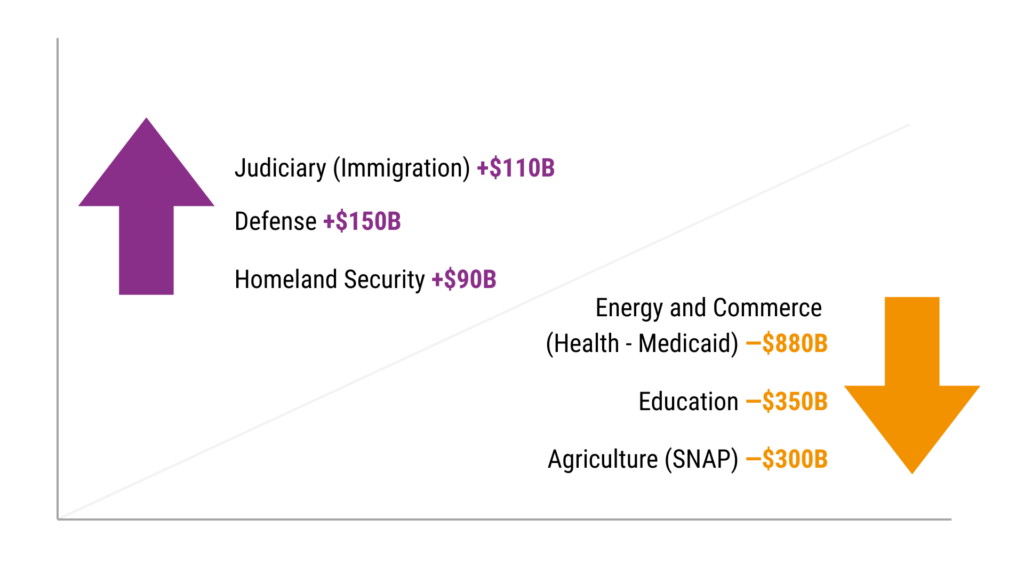
On Thursday, May 22, 2025, the U.S. House of Representatives voted 215-214 to advance the 2025 budget reconciliation bill, H.R. 1. The bill includes deep budget cuts to federal educational programs, food assistance, and health care over the next ten years in order to pay for the Trump Administration’s top priorities, including increasing defense spending, extending tax breaks, and raising the debt ceiling by $4 trillion. The bill is now making its way through the Senate’s budget reconciliation process.
Congressional leaders have set a deadline of getting a final bill to President Trump by July 4th. In order for that to happen, both chambers must agree on identical language, which may require another vote in the House.
📌 Note: This article covers the 2025 budget reconciliation bill, which is different from the Trump Administration’s FY2026 budget proposal that calls for eliminating EHCY funding. For more on that proposal, click here.
Below are key provisions impacting children, youth, and families experiencing homelessness in three areas: food, health, and education. For each area, we direct readers to a specific action alert in order to better target advocacy efforts at this stage of the Senate process.
Food Assistance (Supplemental Nutrition Assistance Program – SNAP)
The House-passed bill would cut nearly $300 billion from SNAP over the next ten years. SNAP provides food for 40 million people – including 16 million children. According to the Congressional Budget Office, this bill would cut food assistance benefits for 1 in 5 children across the country, and 420,000 children would have less food to eat because of the loss of the automatic eligibility for free school meals, summer food assistance, and WIC (Special Supplemental Nutrition Program for Women, Infants, and Children).
Health Care (Medicaid)
The House passed bill would cut more than $700 billion in funding for Medicaid over the next ten years. According to the Congressional Budget Office, the Medicaid changes would result in 7.6 million people no longer qualifying for the program.
Medicaid is the fourth largest federal funding source for public schools. Cuts to Medicaid would result in reductions to school health staff and mental and behavioral health staff – services that are essential for many students experiencing homelessness. The Medicaid provisions of the House-passed bill also would reduce children’s ability to access school meals, which are a key source of nutrition for children and youth experiencing homelessness.
In addition, the bill would require documentation of 80 hours of work or participation in other qualifying programs. While many people who are experiencing homelessness are working, it will be extremely difficult for them to provide proof of employment and report hours without access to phone or internet services; similarly, homeless families and youth who may be exempt from the work requirements will struggle to prove and re-prove their exemption status. Address verification and citizenship verifications will create barriers for U.S. citizens who are eligible for Medicaid, and who are homeless, simply because they lack an address and documentation.
Education (Pell grants, student loans, private school vouchers)
The House-passed bill includes more than $330 billion in cuts to education programs over the next ten years with student aid provisions taking effect in the 2026-2027 school year. Here are the key highlights:
- Establishes a $20 billion school voucher program. The House-passed bill would create a federal tax credit for individuals who donate to groups that provide school choice scholarships to students. The scholarships would be available for students from families with incomes up to 300 percent of their area’s median gross income. This would divert federal funding away from the public school system, which serves the vast majority of homeless students, in order to fund the education of more advantaged students at private schools.
- Increase the number of credits required to meet the definition of full-time enrollment for Pell Grant eligibility from 12 credits per semester to 15 credits per semester.
- The Congressional Budget Office (CBO) found that more than half of students currently enrolled would be impacted by this specific provision resulting in less award money, and that 20% of current students would enroll in additional credits.
- Additionally, NCAN calculated that increasing the threshold to 15 credits to be considered full-time would result in a $1,479 cut to the maximum Pell Grant of $7,395 for any student taking 12 credits, which is approximately a quarter of Pell recipients. Those students’ Pell award would drop to $5,916 if the legislation were enacted.
- Overall, the CBO projects that this provision alone would reduce federal financial aid by $7.1 billion over the next ten years.
- Eliminate Pell Grant eligibility for students who are enrolled less than full-time.
- CBO projects that this provision would impact about 10% of students in recent academic years, and that roughly two-thirds of those students would likely lose their awards. This would result in roughly $687 million less in financial aid going to students through 2034.
- According to the Hope Center, this provision alone could cut off access to more than 912,000 low-income students attending college.
- Eliminate new subsidized loans for all undergraduate students starting with the award year 2026-27, making exceptions for presently enrolled students. Students would be required to take on higher-cost unsubsidized loans up to a certain cap, determined by the median cost of attendance of the degree program in which they are enrolled. This would only pertain to new borrowers and would not impact students who already have an unsubsidized loan.
- Requires institutions of higher education to repay portions of unpaid loans. This requirement may lead to admissions selection bias and ultimately limit access to higher education for lower income households.
Other Provisions
Temporarily increases the Child Tax Credit to $2,500 through 2028, then resets it to $2,000 in 2029, where its growth will be tied to inflation. While this small increase would assist some families, it does little to move the needle on child poverty – especially when considered alongside massive cuts to SNAP and Medicaid.
For more detailed information, NCSL has compiled a tracker of key provisions in the reconciliation process.