
FAFSA data shows increased access to financial aid for homeless and foster youth in 2023–24
Federal data show a 28% increase in FAFSA completions among homeless youth and a 9% increase among foster youth in 2023–24—highlighting early impacts of the FAFSA Simplification Act. Learn more about the key findings, including the role of school district liaisons, decline in unaccompanied determination requests, and what’s needed to sustain momentum in future FAFSA cycles.
Data Shows Promising Gains in FAFSA Completion
Federal data released in April 2025 show a significant increase in the number of homeless and foster youth who completed the FAFSA during the 2023–2024 award year—the first year that several new federal policies for these students were implemented. While the following year (2024–2025) was plagued by extensive delays and technical issues during the rollout of the revamped FAFSA, the 2023–2024 data offers promising signs. The data suggest that, once fully implemented, the new policies will remove financial aid barriers for even greater numbers of homeless and foster youth.
Simplifying the FAFSA: New Policies Support Homeless and Foster Students
Completing the Free Application for Federal Student Aid (FAFSA) is a critical step toward college enrollment and success. Yet youth experiencing homelessness and youth in foster care face longstanding and well-documented barriers to accessing the aid that they need to pursue education beyond high school.
In response to these barriers, Congress enacted specific policies to streamline the FAFSA for homeless and foster youth in the FAFSA Simplification Act. These reforms expanded the number of entities who can make determinations of a youth’s homelessness or foster care status; removed burdensome requirements to prove homelessness every year; and required financial aid administrators to accept certain third-party determinations. Additionally, financial aid administrators must make timely homeless and foster youth determinations when outside documentation is unavailable.
The U.S. Department of Education (ED) issued comprehensive guidance on these provisions in April 2023 and July 2024 to support implementation. In addition, some states have enacted universal FAFSA laws that require FAFSA completion as a condition of high school graduation.
Key Finding #1: Between 2022-2023 and 2023-2024, the number of unaccompanied homeless youth (UHY) FAFSA determinations increased by 28%.
All states reported increases, except for Alaska and Idaho. The number of foster youth FAFSA determinations increased by 9%. All states reported increases, except Connecticut and Nevada. For both populations, the number of FAFSA determinations surpassed pre-pandemic numbers.

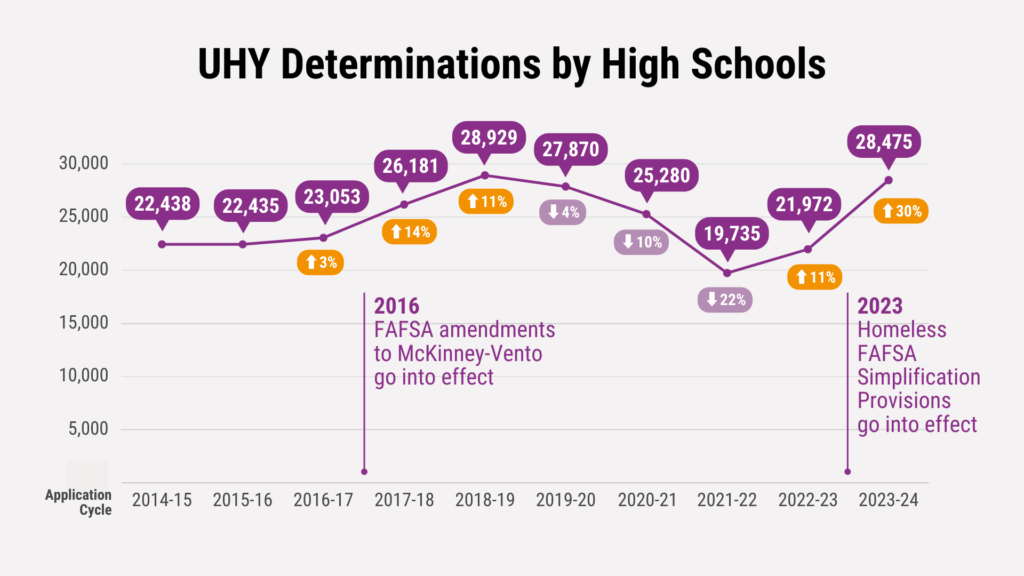
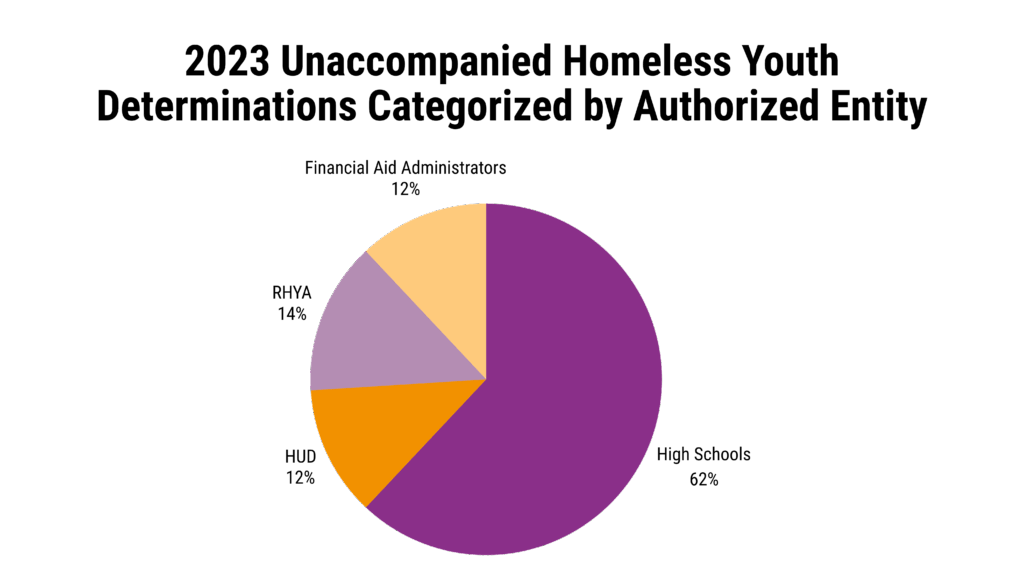
Key Finding #2: The majority of UHY determinations (62%) were made by K12 school district homeless liaisons or their designees.
UHY determinations made by school district homeless liaisons increased by 30% between 2022-2023 and 2023-2024.
Under the Higher Education Act, certain entities are authorized to make determinations of an unaccompanied homeless youth’s status, which then qualifies youth as an independent student on the FAFSA.
Under the FAFSA Simplification Act, the list of authorized entities was expanded to include school district homeless liaisons and their designees, TRIO and GEAR UP directors or designees, and other programs serving individuals experiencing homelessness were included as authorized entities to make UHY FAFSA determinations.
The 2023-2024 FAFSA form did not accurately reflect the newly expanded list of authorized entities in time for the October 1, 2022 release, although the provisions were in effect. Therefore, the 2023-2024 FAFSA data only include school district homeless liaisons, Runaway and Homeless Youth Act directors or their designee, HUD Homeless Assistance Act directors of their designee, or financial aid administrators.
The chart below shows the percentage of determinations made by each authorized entity.
Key Finding #3: Undetermined requests for homelessness consideration decreased by 2% between 2022-2023 and 2023-2024. This is the first decrease after a steady five-year growth.
Youth who believe they are unaccompanied homeless youth, but do not have a determination from an authorized entity, may request a determination from a financial aid administrator. ED tracks the number of applicants whose homeless status remains unknown because no determination had been made in response to their request.
According to ED, the reasons for undetermined requests “could include not attending or following up with the school, or not being determined as an unaccompanied homeless youth.”
However, SchoolHouse Connection’s experience — both with the young people served directly in our Youth Leadership and Scholarship program, and with the network of educators and service providers working directly with young people — is that homeless youth continue to face barriers in receiving determinations from financial aid administrators (FAAs).
Therefore, a decrease in the number of undetermined UHY FAFSA requests may be an indication that the new FAFSA Simplification Act provisions, comprehensive guidance from ED, and dedicated training have helped inform financial aid administrators of their responsibility to provide UHY determinations.

Key Finding #4: Universal FAFSA state laws appear to be correlated with an increase in the number of UHY and foster youth FAFSA determinations. The table below shows year-over-year changes in determinations for states with such laws, as well as trends after their first year of implementation.
| State | Effective FAFSA Cycle | UHY % Change (First Year of Law) | UHY % Change (2023) | Foster % Change (First Year of Law) | Foster % Change (2023) |
|---|---|---|---|---|---|
| Louisiana* | 2017-2018 | +20% | +22% | +6% (pulled from 2016 numbers because 2017 foster data is missing) | -10% (pulled from 2016 numbers because 2017 foster data is missing |
| Illinois | 2020-2021 | -10% | +23% | -3% | +8% |
| Alabama | 2021-2022 | +19% (first + in four years) | +38% | +4% | +12% |
| Texas | 2021-2022 | +25% increase (first + in four years) | +62% | +6% | +15% |
| Colorado Grant Program | 2021-2022 | +11% (first + in four years) | +40% | -4% | +10% |
| Maryland | 2022-2023 | +32% | N/A | +7% | N/A |
| California | 2022-2023 | +38% | N/A | +11% | N/A |
| *Louisiana law was repealed for the 24-25 school year | |||||
While data from the 2023-2024 FAFSA cycle indicate progress in increasing the number of UHY and foster youth FAFSA applicants, the following year (2024-2025) presented significant challenges. The roll out of the 2024-2025 FAFSA was marked by extensive delays, technical glitches, and miscommunication from ED. These issues impeded many students’ ability to complete their financial aid applications and pursue higher education.
In contrast, the 2025-2026 FAFSA appears to be much more functional. SchoolHouse Connection is actively working to increase awareness and implementation of the FAFSA provisions for homeless and foster youth, and address challenges that may arise.
To explore more resources on financial aid, view our page here.