FAFSA Form Templates for Unaccompanied Homeless Youth Determinations
This letter is designed to help confirm the independent student status of unaccompanied homeless youth. Download and customize these templates to support your work in your school district, financial aid office, shelter, transitional living program, or street outreach program.
Why use these sample FAFSA letters for unaccompanied homeless youth documentation?
These unaccompanied homeless youth sample form letters help determine independent student status for the FAFSA. Download and customize these templates to support your work in your school district, financial aid office, shelter, transitional living program, or street outreach program. Other common terms used to describe this letter include:
Applicable for a student enrolling in college between July 1, 2027 – June 30, 2028. Feel free to copy or download this document directly. No need to seek our permission or use the share function.
Applicable for a student enrolling in college between July 1, 2026 – June 30, 2027. Feel free to copy or download this document directly. No need to seek our permission or use the share function.
Downloads: Unaccompanied Homeless Youth FAFSA Form Templates
The McKinney-Vento Act requires school district liaisons to inform unaccompanied homeless youth of their status as independent students for financial aid (the Free Application for Federal Student Aid, or FAFSA) and help them obtain documentation of that status.
To help implement this policy, we’ve prepared a sample form letter to determine the independent student status of unaccompanied homeless youth for the FAFSA.
What is the best way to start using the sample forms?
Download these Google documents directly–or select “make a copy” to add a duplicate to your Google Drive. No need to seek our permission or use the share function. Edit these as appropriate for your school district, financial aid office, shelter, transitional living program, or street outreach program to document an unaccompanied homeless youth determination.
Only authorized individuals can use these forms to confirm a student is unaccompanied and homeless, or unaccompanied, self-supporting and at risk of homelessness for the FAFSA.
A Note for Financial Aid Administrators: If you are requesting a statement from a student, use this template instead.
What is unaccompanied homeless youth documentation for FAFSA?
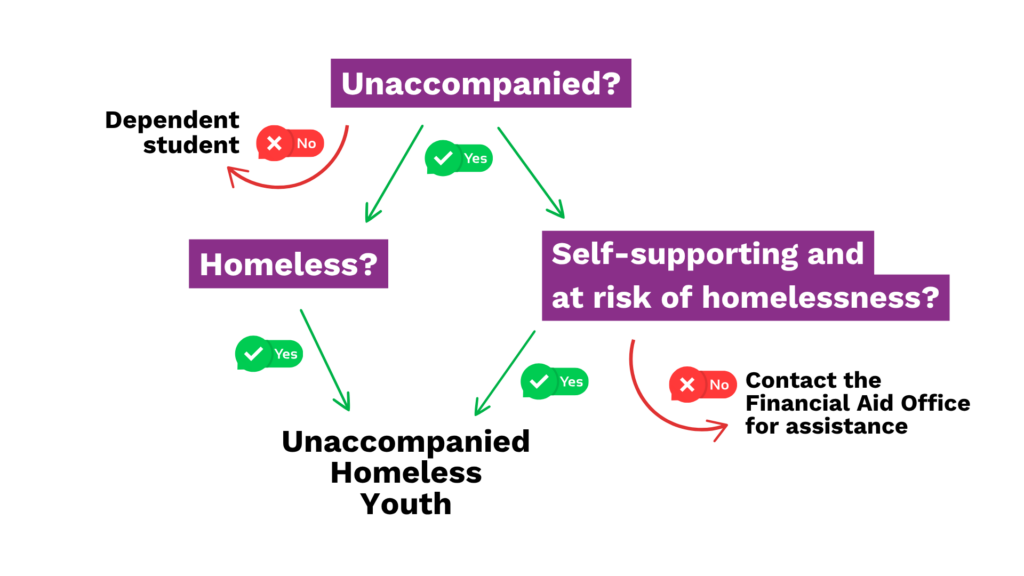
Unaccompanied homeless youth documentation is written verification used to document a student’s status as an independent student on the FAFSA when the student is:
unaccompanied and homeless, or
unaccompanied, self-supporting, and at risk of homelessness
This documentation may be requested under the names of a homeless verification letter, McKinney-Vento verification letter, or homeless youth determination letter. The purpose is the same: to help the student access financial aid without unnecessary delay.
What counts as homelessness for the FAFSA and McKinney-Vento?
For education and FAFSA purposes, the McKinney-Vento Homeless Assistance Act defines “homelessness” as individuals who lack a fixed, regular, and adequate nighttime residence.
Examples of homelessness include:
staying temporarily with others because they have nowhere else to go (often called “doubled-up” or couch surfing)
staying in an emergency shelter, transitional housing program, or similar program
staying in a motel/hotel because there is no safe or stable alternative
living in a car, park, campground, abandoned building, bus/train station, or other place not meant for people to live
staying in substandard housing
If a student’s situation fits the criteria above and they arenot living with a parent or legal guardian, they likely meet the definition of an unaccompanied homeless youth for the FAFSA.
Students can also be considered independent with a homeless youth determination if they are unaccompanied, self-supporting, and at risk of homelessness.
Living on Campus and Breaks
A student living on campus may also be considered experiencing homelessness if they do not have a safe and stable place to stay when the dorms close over breaks.
“Homeless” means lacking a fixed, regular, and adequate nighttime residence. For example, staying with others because they have no other place to go.
These simple definitions help clarify whether a situation meets the homelessness standard. If any of the following are not met, the student is considered homeless:
Fixed: stationary and not subject to change
Regular: used on a predictable, routine, or consistent basis
Adequate: sufficient for meeting physical and psychological needs typically met in a home environment
“Unaccompanied” generally means the student is not living in the physical custody of a parent or guardian.
A student may be at risk of homelessness when their housing may soon stop being fixed, regular, and adequate—for example, if they are facing eviction and do not have a safe, stable place to go.
“Self-supporting” generally means the student pays for their own living expenses, including their housing. In the FAFSA context, this term is used with “unaccompanied” and “at risk of homelessness” to identify students who are on their own and need an independent student determination.
Who can provide a homeless youth determination letter?
Students may obtain unaccompanied homeless youth documentations from authorized entities such as:
School district homeless liaisons (or designees) — also called Mckinney-Vento liaisons
Shelters, transitional housing programs, and street outreach programs (or designees)
Programs that serve youth experiencing homelessness and can verify circumstances
Director (or designee) of a TRIO or GEAR UP program
Financial aid administrator who previously made a determination of homeless youth during the same or previous year
These authorized individuals can provide a letter, such as the templates on this page, or a statement through a documented phone call with the financial aid office, confirming a student is unaccompanied and homeless, or unaccompanied, self-supporting, and at risk of homelessness.
What if a student can’t get unaccompanied homeless youth documentation?
Sometimes a student can’t obtain a determination from a school liaison or program, even if they meet the definitions. In those situations, the college financial aid office must review the student’s circumstances and make the determination based on either a written statement from the student or a documented interview with the student confirming they are unaccompanied and homeless, or unaccompanied, self-supporting, and at risk of homelessness.
Per federal guidance from the U.S. Department of Education, “if a student indicates that they are an unaccompanied homeless youth—or unaccompanied and self-supporting youth at-risk of homelessness—and the student is unable to provide documentation from at least one of the entities listed above, FAAs must review the student’s circumstances and make the determination themselves.”
Determinations of unaccompanied homeless youth, or unaccompanied, self-supporting, and at risk of homelessness, must be made on a case-by-case basis without regard to the reasons why a student may be unaccompanied and experiencing homelessness.
What documentation is acceptable for homeless youth determinations (and what shouldn’t be required)?
Documentation may include: a documented phone call or written statement. If the student has a documented determination from an authorized entity, institutions should not request additional documentation unless there is conflicting information.
If a student is unable to obtain documentation from an authorized entity, the financial aid office must make a determination of the student’s unaccompanied homeless youth status based on either a written statement or a documented interview with the student.
Also, many students struggle with a stable mailing address. Students can use an address where they can reliably receive mail (such as a trusted contact or an institution’s address with permission and a process in place).
A very important reminder: determinations should focus on whether the student meets the definitions—not the reasons why the student is unaccompanied and/or experiencing homelessness.
The FAFSA Simplification Act requires that students who are independent through an unaccompanied homeless youth determination shall be presumed independent in subsequent years at the same institution. If the student’s situation has not changed, the financial aid office does not need new documentation of homelessness each year.
What to include in unaccompanied homeless youth documentation?
To reduce delays and back-and-forth, a FAFSA homeless determination letter should clearly include:
The student’s name (and any identifying details your program/school is permitted to share)
A clear statement that the student is unaccompanied and meets the homelessness definition (or is unaccompanied, self-supporting, and at risk of homelessness)
The time period or context relevant to the FAFSA year (when applicable)
The signer’s name, title, organization, and contact information
Signature (or other verification method used by the issuing organization)
Homeless Documentation Letter Example
Below is a short example of the type of language that can appear in unaccompanied homeless youth documentation–which would accompany the student’s name and limited identifying information as appropriate (avoid unnecessary sensitive information), and a mailing address, as well as contact information and role specification of the person making the unaccompanied homeless youth determination for the FAFSA. Use the downloadable templates above for the full format.
“To Whom It May Concern:
This form conveys my determination that after [DATE], 20XX*, this student was an unaccompanied homeless youth, as defined by the FAFSA Simplification Act (Public Law No: 116-260). I am authorized to document this student’s living situation and determine his/her independent student status as an unaccompanied homeless youth, or an unaccompanied, self-supporting, youth at risk of homelessness. Financial aid administrators must accept this documentation, unless there is specific documented conflicting information. Please address any questions to me at the number or e-mail address listed below.”
*Use the date of July 1, 2025 for the 2026-27 FAFSA. Use the date of January 1, 2026 for the 2027-28 FAFSA
Can the financial aid office ask for other documents after receiving documentation for homeless youth?
After submitting the FAFSA, some students are selected for ID verification—a process used to confirm identity and prevent fraud. This process is separate from making homeless youth determinations for the FAFSA. The financial aid office may require other documentation, such as IDs, taxes, or other statements, that are unrelated to the homeless youth determination. These must be completed before a student can receive financial aid. This page explains what ID verification means, how it’s different from an unaccompanied homeless youth determination, and the steps students can take if selected. On that page, we also provide resources to help youth obtain a government-issued photo ID.
FAQs
It’s important to clarify that when the term “McKinney-Vento letter” is used, that could be referring to one and/or two different things:
a school-based letter verifying eligibility under McKinney-Vento (K–12 context), and/or
a FAFSA-focused letter used to support independent student status as an unaccompanied homeless youth.
Both rely on the same core homelessness definition (fixed, regular, adequate), but the FAFSA determination workflow may involve different determiners and next steps—especially once the student is applying to or enrolled in college. If you support students at the high school level, useour FAFSA screening tool and checklist designed to help counselors and school staff determine if students are experiencing homelessness or in foster care, along with next steps to keep them on track with completing the FAFSA.
For a quick McKinney-Vento overview, see our McKinney-Vento quick reference. For liaison-facing guidance on making homeless youth determinations consistently, use this reference to determine eligibility for services under the McKinney-Vento Act. The guiding questions in the resource can help liaisons gather information in a sensitive, supportive, and confidential manner.
Students may obtain unaccompanied homeless youth documentations from authorized entities such as:
School district homeless liaisons (or designees) — also called Mckinney-Vento liaisons
Shelters, transitional housing programs, and street outreach programs (or designees)
Programs that serve youth experiencing homelessness and can verify circumstances
Director (or designee) of a TRIO or GEAR UP program
Financial aid administrator who previously made a determination of homeless youth during the same or previous year
These authorized individuals can provide a letter, such as the templates on this page, or a statement through a documented phone call with the financial aid office, confirming a student is unaccompanied and homeless, or unaccompanied, self-supporting, and at risk of homelessness.
These unaccompanied homeless youth sample form letters help determine independent student status for the FAFSA. Download and customize these templates to support your work in your school district, financial aid office, shelter, transitional living program, or street outreach program. Other common terms used to describe this letter include:
To reduce delays and back-and-forth, a FAFSA homeless determination letter should clearly include:
The student’s name (and any identifying details your program/school is permitted to share)
A clear statement that the student is unaccompanied and meets the homelessness definition (or is unaccompanied, self-supporting, and at risk of homelessness)
The time period or context relevant to the FAFSA year (when applicable)
The signer’s name, title, organization, and contact information
Signature (or other verification method used by the issuing organization)
Sometimes a student can’t obtain a determination from a school liaison or program, even if they meet the definitions. In those situations, the college financial aid office must review the student’s circumstances and make the determination based on either a written statement from the student or a documented interview with the student confirming they are unaccompanied and homeless, or unaccompanied, self-supporting, and at risk of homelessness.
Per federal guidance from the U.S. Department of Education, “if a student indicates that they are an unaccompanied homeless youth—or unaccompanied and self-supporting youth at-risk of homelessness—and the student is unable to provide documentation from at least one of the entities listed above, FAAs must review the student’s circumstances and make the determination themselves.”
Determinations of unaccompanied homeless youth, or unaccompanied, self-supporting, and at risk of homelessness, must be made on a case-by-case basis without regard to the reasons why a student may be unaccompanied and experiencing homelessness.
For education and FAFSA purposes, the McKinney-Vento Homeless Assistance Act defines “homelessness” as individuals who lack a fixed, regular, and adequate nighttime residence.
Examples of homelessness includes:
staying temporarily with others because they have nowhere else to go (often called “doubled-up” or couch surfing)
staying in an emergency shelter, transitional housing program, or similar program
staying in a motel/hotel because there is no safe or stable alternative
living in a car, park, campground, abandoned building, bus/train station, or other place not meant for people to live
staying in substandard housing
If a student’s situation fits the criteria above and they arenot living with a parent or legal guardian, they likely meet the definition of an unaccompanied homeless youth for the FAFSA.
Students can also be considered independent with a homeless youth determination if they are unaccompanied, self-supporting, and at risk of homelessness.
If you are filling out the FAFSA for the first time and are an unaccompanied youth who is homeless or at risk of being homeless and self-supporting, you will need to provide information about your status. This resource will help you navigate answering the questions about homelessness and how to request an unaccompanied homeless youth determination.
Understanding the definition of homelessness is essential for accessing education and support services. If you lack a fixed, regular, and adequate nighttime residence, you may meet the homeless definition under federal education law. This guide explains real-life examples and how you can access educational resources, housing help, and financial aid.
Under the education subtitle of the McKinney-Vento Homeless Assistance Act, the term “homeless children and youth” means individuals who lack a fixed, regular, and adequate nighttime residence. Your living situation meets the definition of homelessness for youth if you live with a parent or guardian in any of these situations:
Temporarily Staying with Other People
Staying in Emergency or Transitional Shelters
Staying in Motels, Campgrounds, Cars, Parks, Abandoned Buildings, Bus or Train Stations, or any Public or Private Place not Designed for Humans to Live in
Staying in Substandard Housing
If you are not living with a parent or guardian, but your situation fits the criteria, you meet the definition of an unaccompanied homeless youth.
After submitting the FAFSA, some students are selected for ID verification—a process used to confirm your identity and prevent fraud. This page explains what ID verification means, how it’s different from an unaccompanied homeless youth determination, and the steps you can take if you’re selected. We also provide resources to help you obtain a government-issued photo ID.
The FAFSA also screens all applicants to verify their identity while completing the form. Most applicants will not notice a change to the FAFSA process, but some students may be selected to take a picture of their government-issued photo ID before they submit the FAFSA. If a student is unable to complete this process, they can still submit the FAFSA, but they will be required to provide an ID to the financial aid office before they can receive financial aid.
The FAFSA Simplification Act includes new requirements for Financial Aid Administrators (FAAs) to make determinations of a youth’s status as unaccompanied and homeless, or as unaccompanied, self-supporting, and at risk of homelessness if students cannot provide a determination from an authorized entity.
Under the law, and summarized in ED’s July 2024 guidance on unaccompanied homeless youth and federal financial aid, FAAs must make a case-by-case decision that is:
Based upon a written statement from, or a documented interview with the student that confirms that they are an unaccompanied homeless youth, or unaccompanied, at risk of homelessness, and self-supporting; and
Made without regard to the reasons that the student is unaccompanied and/or homeless
Financial aid administrators can provide students this template to assist them in providing a written statement to confirm that they are an unaccompanied homeless youth, or unaccompanied, at risk homelessness and self-supporting.
Many students from immigrant and mixed-status families face housing disruptions that affect their ability to access higher education. Immigration enforcement efforts can compromise family stability, making it difficult for caregivers to work and pay rent. In other cases, the detention or deportation of a family member can jeopardize a student’s living situation, putting them at risk of homelessness. Students may also worry about pursuing higher education and sharing sensitive family information.
This guide is intended to help high school counselors and financial aid professionals support students in immigrant and mixed-status families who are at risk of homelessness.
The guide walks counselors through the process for determining if a student is FAFSA eligible and meets the criteria of an unaccompanied homeless youth (UHY). It also identifies likely scenarios counselors may encounter and answers common questions about access to aid for students who face housing risks as a result of their or their family members’ immigration status.