Congressional FY26 Deal: Key Wins for Homeless Children and Youth
This article summarizes key provisions in Congress’s FY2026 appropriations deal affecting children, youth, and families experiencing homelessness, with a focus on education, early childhood, higher education, and housing programs.
Update (as of February 3, 2026):
On Tuesday, February 3, Congress passed final FY2026 appropriations legislation for early care, education, housing and homelessness programs. The final bill includes continued funding for the McKinney-Vento Act’s Education of Homeless Children and Youth program, along with guardrails to help ensure funding is released on time.
As we noted in our federal policy update tracker, a dispute over federal immigration enforcement practices was the central sticking point that delayed a broader agreement and triggered a partial government shutdown. Congressional leaders and the White House ultimately agreed to decouple funding for the Department of Homeland Security (DHS) – which includes funding for Immigration and Customs Enforcement – from the rest of the package, passing a two-week continuing resolution for DHS while negotiations continue.
Overall, the final FY2026 funding and policy language includes critical support for children, youth, and families experiencing homelessness.
FY2026 Appropriations: What Congress Included
On January 20, 2026, Congress released its negotiated FY2026 appropriations legislation for education, health and human services, and housing and homelessness agencies. We are pleased to share that the compromise language includes critical support for federal programs supporting children, youth, and families experiencing homelessness.
This progress did not happen by chance.
Over the past year, SchoolHouse Connection helped more than 100 homeless liaisons and community partners meet with Members of Congress from both parties and in both chambers, sharing real-world impacts of federal funding on the lives of children, youth, and families. That advocacy is reflected in the bill’s preservation of funding for the Education for Homeless Children and Youth (EHCY) program and a significant victory in added flexibility for EHCY to cover short-term, emergency housing such as hotels or motels when necessary to keep students in school.
The inclusion of this provision underscores what is possible when policymakers hear directly from you.
Beyond EHCY, the bill’s rejection of proposed cuts across many issue areas underscores the power of broad coalitions – powered by you – to protect early childhood, education, homeless services, and housing programs.
Previous Updates:
Congress failed to complete action on the six remaining FY2026 appropriations bills before the statutory funding deadline, resulting in a partial federal government shutdown as of 12:01 a.m. ET on January 31. While the U.S. Senate passed a bipartisan compromise funding package on January 30, the U.S. House of Representatives has not yet voted on this package. The Senate compromise reflects broad bipartisan support and has the backing of the White House and President Trump. However, it must still be passed by the U.S. House of Representatives and signed by the President before becoming law. The House reconvenes on Monday, February 5 and will consider the Senate’s funding package.
The Senate funding measure would provide full‐year FY2026 appropriations for five of the six outstanding spending bills covering departments such as Education (ED), Housing and Urban Development (HUD), Health and Human Services (HHS), Defense, Labor, and others. The Senate’s amended package also includes a two-week continuing resolution (CR) to extend funding for the Department of Homeland Security (DHS) — including Immigration and Customs Enforcement (ICE) and Customs and Border Protection — while lawmakers continue negotiations over policy conditions linked to immigration enforcement reforms. The ongoing dispute over the DHS appropriations bill, driven in part by concerns about ICE and federal immigration enforcement practices following recent high-profile incidents in Minneapolis, was the central sticking point that prevented an earlier resolution and led to the shutdown.
IMPORTANT NOTICE: While agencies such as the U.S. Departments of ED, HHS, and HUD are operating under shutdown contingency plans, the federal protections under the education subtitle of the McKinney-Vento Act remain in place, and the shutdown does not affect the current school year (2025-2026) McKinney-Vento funding already enacted into law. Additionally, programs with already enacted FY2026 appropriations or mandatory funding streams, such as SNAP and WIC, continue without interruption.
- The House is expected to take up the legislation this week. If the legislation passes the House, it will move on to the Senate for consideration next week. Congress must pass final legislation, or a Continuing Resolution, by January 30 in order to avoid a partial government shutdown.
- SHC will continue to monitor this bill and will provide key updates.
Below is a breakdown of the final bill’s funding amounts and policy provisions for key programs.
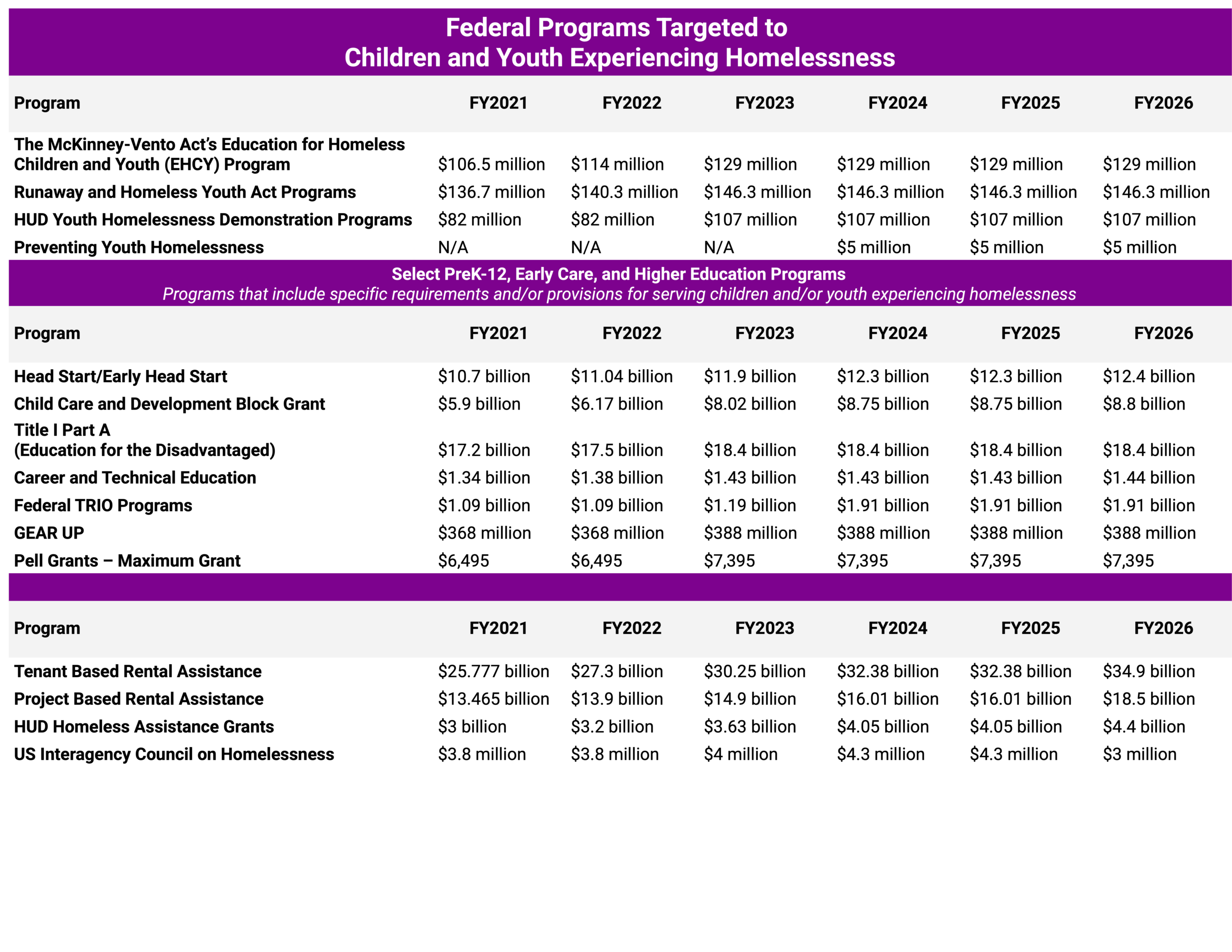
FY2026 Funding Levels for Key Federal Programs Supporting Children, Youth, and Families Experiencing Homelessness
PreK-12 Education
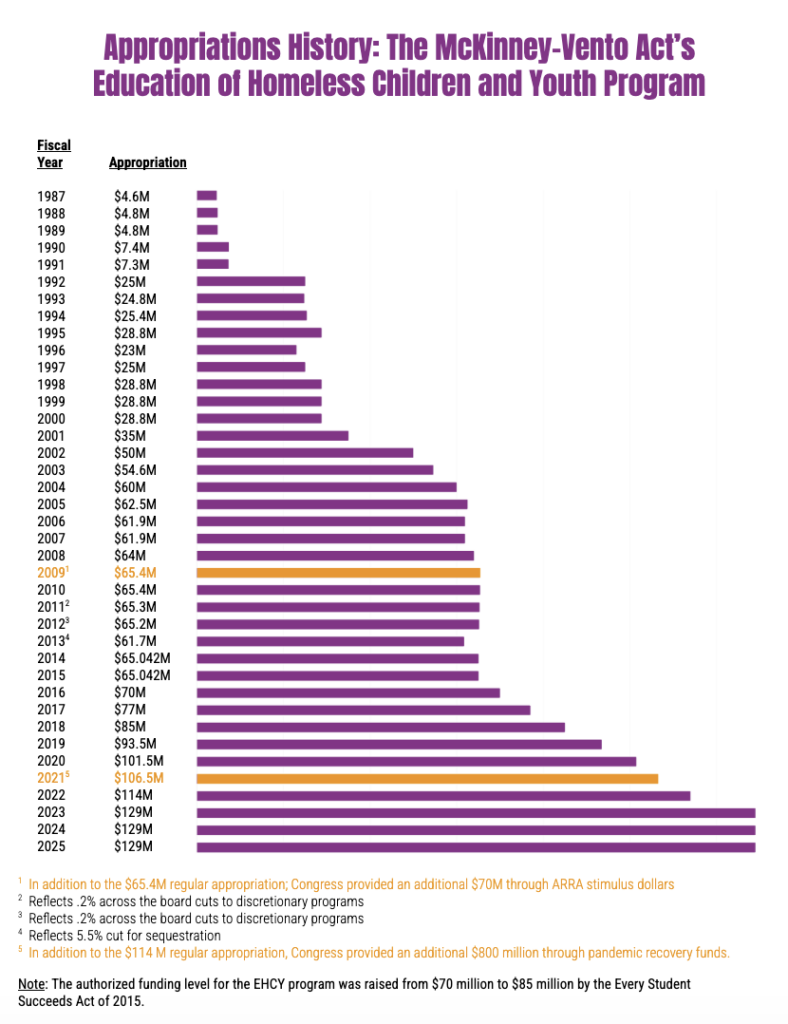
- Maintains funding for the Education for Homeless Children and Youth (EHCY) program at the current level ($129 million)
- Directs the U.S. Department of Education (ED) to issue guidance on the use of EHCY funds for short-term emergency housing on a case-by-case basis if reasonable and necessary to facilitate school attendance, and as a last resort when other funding sources are not readily available.
- Requires ED to release EHCY, IDEA, and ESEA funds as soon as the funds become available, and to maintain staffing levels sufficient to carry out its responsibilities
- Continues a prohibition on ED transferring programs and funds to other agencies without Congress expressly authorizing it in appropriations law. (Note: litigation on ED’s interagency transfers is ongoing.)
- Maintains or increases funding for most PreK-12 education programs, including:
- Title I, Part A (Education for the Disadvantaged): $18.4 billion (an increase of $20 million)
- Title I, Part C (Migrant Education Program): $376 million (same as current level)
- Title III (English Language Acquisition): $890 million (same as current level)
- Individuals with Disabilities Education Act: $14.2 billion (an increase of $20 million)
- Full-Service Community Schools: $150 million (same as current level)
Early Childhood
- Maintains or increases funding for most federal early childhood programs.
- Child Care and Development Block Grant (CCDBG): $8.8 billion (an increase of $85 million)
- Head Start / Early Head Start: $12.4 billion (an increase of $85 million)
- Preschool Development Grants Birth Through Five (PDGB-5): $315 million (same as current level)
- IDEA Preschool Grants (Part B): $420 million (same as current level)
- IDEA Grants for Infants and Toddlers (Part C): $540 million (same as current level)
- Requires HHS to send CCDBG funds to states at least quarterly.
- Directs HHS to make Head Start continuation awards no later than the day after a grant period expires.
Higher Education
- Directs ED to correct wrongful “provisional independence” errors for homeless youth, publish FAFSA data on homeless and foster youth within 60 days, and brief Congress within 90 days on oversight of institutions with high rates of unfulfilled Unaccompanied Homeless Youth determination requests.
- Maintains funding for most federal higher education programs:
- Pell Grants: $22.5 billion with a maximum Pell award at $7,395 for the 2026-2027 school year (same as current level)
- Basic Needs Grant Program: $10 million, and directs ED to carry out this program as Congressionally mandated.
- Child Care Access Means Parents In Schools (CCAMPIS): $75 million (same as current level) and includes language requiring a new competition in 2026.
- Gaining Early Awareness and Readiness for Undergraduate Programs (GEAR UP): $388 million (same as current level)
- TRIO: $1.2 billion (same as current level)
- Federal Work Study: $1.2 billion (same as current level)
- Federal Supplemental Educational Opportunity Grants (SEOG): $910 million (same as current level)
- Postsecondary Student Success Grant Program: $45 million (same as current level)
Homeless Assistance and Housing Programs
- Runaway and Homeless Youth Act programs: $143.6 million (same as current level), and directs ACF to issue timely notices of funding opportunities and awards for RHYA programs, and to issue separate funding opportunities for the Street Outreach Program, Basic Center Program, Transitional Living Program, and Maternity Group Homes.
- Preventing Youth Homelessness: $5 million (same as current level). Directs the Administration for Children and Families at the U.S. Department of Health and Human Services to continue its Preventing Youth Homelessness demonstration, funding planning and implementation grants to help communities prevent homelessness among youth ages 12–26.
- Homeless Students Report Language: Congress acknowledges the increase in K-12 students experiencing homelessness and directs HUD to identify current policies of locating homeless students and to work with federal partners to provide adequate housing resources.
- HUD Homeless Assistance Grants (Continuum of Care Funding): $4.4 billion, an increase of $336 million.
- Requires HUD to automatically renew all expiring CoC grants for a 12-month bridge period – starting with projects expiring in early 2026 – and to continue renewing projects throughout 2026 if FY25 CoC NOFO awards are delayed. (Note: litigation on HUD’s 2025 NOFO is ongoing.)
- Tenant-Based Rental Assistance: $34.9 billion. This increase is likely to cover the cost of all voucher renewals.
- Tenant Protection Vouchers (TPVs): $601 million, a $264 million increase to enable Public Housing Authorities (PHAs) in helping current Emergency Housing Voucher (EHV) families transition to new assistance.
- Project-Based Rental Assistance: $18.5 billion, an increase of $1.6 billion
- United States Interagency Council on Homelessness: $3 million (same as current level)
For More Information:
Please contact TJ Lucas at tj@schoolhouseconnection.org.
Historical Funding Chart of Federal Programs
Authorization & Funding History of the McKinney-Vento Act’s EHCY Program